
MuSig2: Protocol-Level Design and Cryptographic Analysis for Efficient Bitcoin Multisignatures
A Comprehensive Exploration of MuSig2's Development, Security Model, and Practical Applications in Bitcoin's Ecosystem

Abstract
Bitcoin’s demand for scalable, private, and efficient multisignature schemes has driven continuous cryptographic innovation. Traditional multisig constructions, reliant on OP_CHECKMULTISIG, suffer from privacy leaks, inefficient space usage, and lack of aggregation. MuSig2, built atop Schnorr signatures and the foundation laid by MuSig1, solves these problems. It enables the creation of single public keys and single signatures from multiple signers with minimal interaction while retaining security against rogue-key and nonce-based attacks. This article presents a detailed technical exploration of MuSig2’s design, security model, and operational mechanics at the protocol level.
Historical Evolution
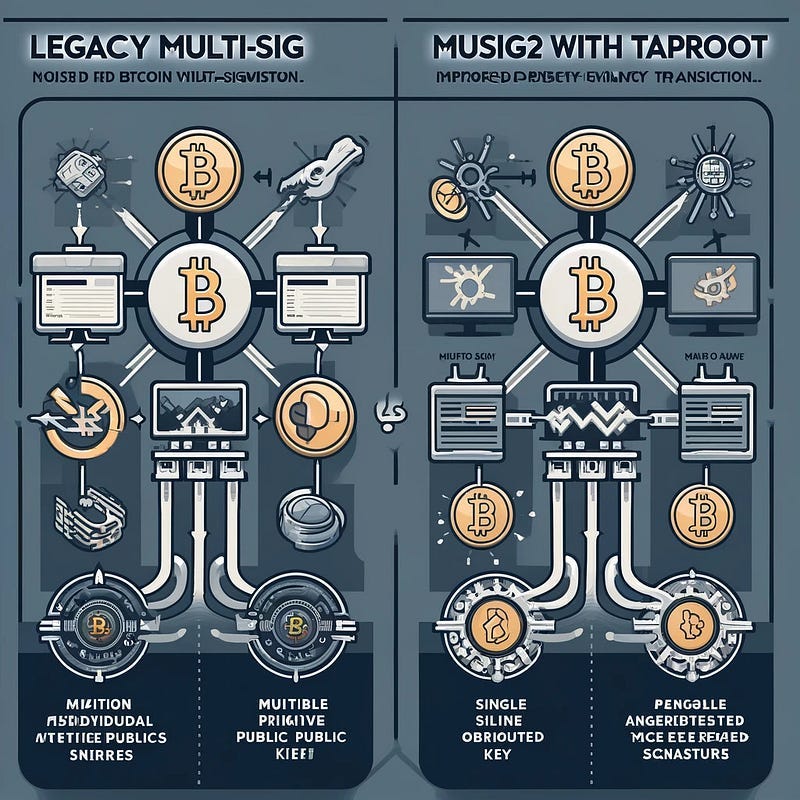
Bitcoin’s earliest multisignature model, using OP_CHECKMULTISIG, revealed the exact number of signers, the entire set of public keys, and the threshold condition directly on-chain. This transparency undermined privacy and bloated transaction sizes proportionally to the number of participants.
The theoretical foundation for improving multisignature schemes arrived with Schnorr signatures, proposed by Claus-Peter Schnorr. Schnorr signatures’ linear properties allow multiple public keys and signatures to be aggregated efficiently. However, due to patent restrictions and Bitcoin’s early commitment to ECDSA, Bitcoin could not adopt Schnorr until much later. The patent on Schnorr expired in 2008, but it was only with the Taproot soft fork (2021) that Schnorr (BIP-340) became available in Bitcoin consensus.
Jonas Nick, Tim Ruffing, and Pieter Wuille developed MuSig1 in 2018. It demonstrated a provably secure multisignature protocol resistant to rogue-key attacks. However, MuSig1 required three rounds of interaction and complex nonce management, making it cumbersome in practice.
Recognizing the operational friction, the same authors proposed MuSig2 in 2020. MuSig2 reduces interaction to two rounds while maintaining the same security guarantees. It also supports preprocessing commitments and easier integration into asynchronous systems, like Lightning Network, without introducing meaningful security trade-offs.
Cryptographic Foundations
MuSig2 operates over the secp256k1 elliptic curve. All operations are modulo the curve order n. Let G denote the curve generator. Private keys are scalars x_i, and public keys are computed as P_i = x_i * G. The hash function H is modeled as a random oracle. The security of MuSig2 relies on the hardness of the discrete logarithm problem in the elliptic curve group.
Protocol Description
MuSig2 splits into two phases: key aggregation and signing.
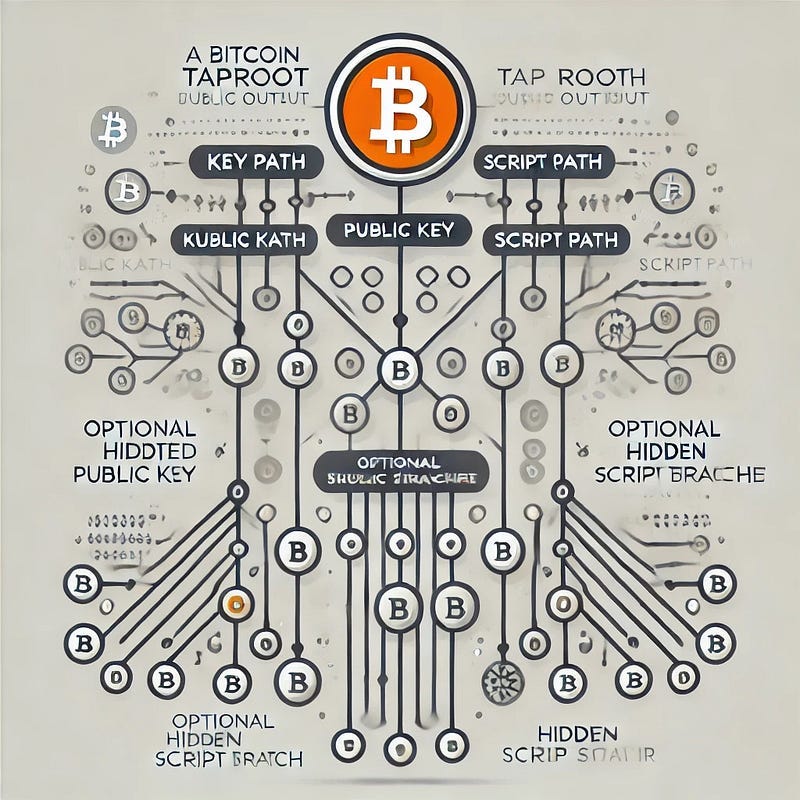
Key Aggregation Phase
Each participant begins with their public key P_i. First, the protocol constructs a hash of the entire participant list:
L = H(P_1 || P_2 || ... || P_n)Each participant’s coefficient c_i is then computed individually as:
c_i = H(L || P_i)This binding ensures that an attacker cannot manipulate keys to cancel others’ contributions, thus preventing rogue-key attacks.
The aggregate public key P is constructed by linear combination:
P = c_1 * P_1 + c_2 * P_2 + ... + c_n * P_nThis final aggregate public key behaves identically to a regular Schnorr public key.
Signing Phase
The signing phase proceeds per message and is split into two rounds, although certain setups allow for preprocessing to collapse this into a single effective round.
Round 1: Nonce Commitment
Each participant selects two random nonces: r_i and s_i. They compute the corresponding curve points:
R_i = r_i * G
S_i = s_i * G
Instead of immediately revealing these points, they commit to the pair (R_i, S_i)by broadcasting a hash:
commitment_i = H(R_i || S_i)This prevents participants from biasing their nonces based on others’, protecting against nonce substitution attacks.
In some pre-coordinated environments (e.g., Lightning opening transactions), participants can skip this round if nonces are pre-generated and securely shared.
Round 2: Signing
Participants reveal their actual pairs after exchanging all commitments.(R_i, S_i)
The aggregated nonce is calculated by summing individual nonces:
R = sum(R_i) + sum(S_i)The challenge ofe binding the aggregate public key, the aggregate nonce, and the message m is computed as:
e = H(P || R || m)Each participant then computes their partial signature:
s_i = r_i + e * c_i * x_iThe final signature scalar s is the sum of all partial signatures:
s = sum(s_i)The full MuSig2 signature on the message m is the pair (R, s).

Verification
Verification proceeds identically to standard Schnorr signature verification. Given a signature(R, s), public key P, and message m, the verifier computes:
e = H(P || R || m)Then checks whether:
s * G == R + e * PIf the equality holds, the signature is valid.
Security Considerations
MuSig2 retains strong unforgeability under chosen-message attacks (UF-CMA) assuming the random oracle model and the discrete logarithm assumption hold.
The use of binding coefficients c_i eliminates rogue-key attacks.
Nonce commitments thwart biasing attacks, which could otherwise expose private keys due to improperly chosen or influenced nonces.
Participants can still compromise their private keys, as in standard Schnorr, if they fail to properly commit to their nonces or reuse nonces across messages.
The protocol easily allows for adaptor signatures, which means you can create conditional signature systems using MuSig2 for things like atomic swaps and Discreet Log Contracts (DLCs).
Improvements Over MuSig1
MuSig2 significantly reduces operational complexity compared to MuSig1.
MuSig1 requires three rounds: key aggregation, nonce commitment, and signing, whereas MuSig2 compresses that process into two rounds, with the potential for one round in pre-shared nonce environments.
MuSig1 requires strict online interaction for nonce generation; MuSig2 decouples nonce generation and signing, allowing better asynchronous behavior.
Security remains at least as strong as MuSig1 in formal analysis, while practical deployment becomes far easier, especially in environments like Lightning Network, where low latency and simple interaction are critical.

Practical Applications
MuSig2 unlocks enhanced privacy and efficiency for multiple Bitcoin use cases.
For Lightning Network, MuSig2 allows the opening and closing of channels with aggregate public keys, removing the need to reveal all channel participants in cooperative closes.
For multisig wallets, MuSig2 provides a one-key, one-signature abstraction regardless of how many cosigners participate.
For vault structures, it enables complex time-locked recovery policies without leaking internal policy details.
For DLCs and cross-chain atomic swaps, MuSig2 allows for smaller and private on-chain setups by using adaptor signatures.
Future Developments
MuSig2 sets the stage for more research and improvements, like FROST (Flexible Round-Optimized Schnorr Threshold Signatures), which expands MuSig2 to allow for signing by a group instead of requiring everyone to sign.
Researchers are exploring batch validation techniques to verify multiple MuSig2 signatures simultaneously at a significantly lower computational cost.
Cross-input signature aggregation, proposed for Bitcoin in future soft forks, would amplify the advantages of MuSig2 by allowing signatures across multiple inputs to be aggregated into one, reducing transaction sizes even further.
Conclusion
MuSig2 stands as a critical upgrade to Bitcoin’s multisignature capabilities.
It retains rigorous security proofs, dramatically improves operational practicality, and aligns with Bitcoin’s long-term goals of scalability, privacy, and efficiency.
By reducing round complexity while maintaining strong security properties, MuSig2 enables widespread deployment across Lightning, multisig wallets, atomic swaps, DLCs, and beyond.
In short, MuSig2 transforms multisig from a heavy, leak-prone process into a lightweight, secure, and scalable cryptographic primitive, fitting perfectly into Bitcoin’s broader vision of self-sovereign, scalable financial infrastructure.
References
Jonas Nick, Tim Ruffing, Pieter Wuille. MuSig2: Simple Two-Round Schnorr Multisignatures. Cryptology ePrint Archive, 2020.
Pieter Wuille et al. BIP-340: Schnorr Signatures for secp256k1. Bitcoin Improvement Proposals.
Jonas Nick, Tim Ruffing, Pieter Wuille. MuSig: Multisignatures for Schnorr Signatures. Cryptology ePrint Archive, 2018.
Bitcoin Core Developers. BIP-341: Taproot: SegWit Version 1 Spending Rules.
You can sign up to receive emails each time I publish.
Link to the original Bitcoin White Paper: White Paper:
Dollar-Cost-Average Bitcoin ($10 Free Bitcoin): DCA-SWAN
Access to our high-net-worth Bitcoin investor technical services is available now: cccCloud
“This content is intended solely for informational use. It is not a substitute for professional financial or legal counsel. We cannot guarantee the accuracy of the information, so we recommend consulting a qualified financial advisor before making any substantial financial commitments.