
MuSig2 and Taproot: Efficient, Private, and Secure Multi-Signature Coordination in Bitcoin
A protocol-level exploration of MuSig2's cryptographic design, Taproot integration, and its impact on scalable multi-party control in Bitcoin.

MuSig2 and Taproot: Efficient, Private, and Secure Multi-Signature Coordination in Bitcoin
Subtitle:
A protocol-level exploration of MuSig2’s cryptographic design, Taproot integration, and its impact on scalable multi-party control in Bitcoin
1. Introduction
Bitcoin’s Taproot upgrade, activated in November 2021, introduced a new era of flexibility, efficiency, and privacy to the protocol. By enabling the use of Schnorr signatures (BIP340) and embedding advanced script structures via Merkleized Abstract Syntax Trees (MAST), Taproot allows complex spending conditions to be expressed succinctly and privately. One of the most important cryptographic primitives made possible by Schnorr is MuSig2, a key and signature aggregation scheme that facilitates efficient, privacy-preserving multi-signature transactions.
This article presents a deep technical examination of MuSig2 with Taproot, exploring its cryptographic construction, protocol-level design, operational benefits, and ideal use cases within the Bitcoin ecosystem. The focus is on practical implementation, security implications, and the architecture of Bitcoin’s native multi-party coordination layer.
2. Cryptographic Motivation and the Evolution Beyond ECDSA
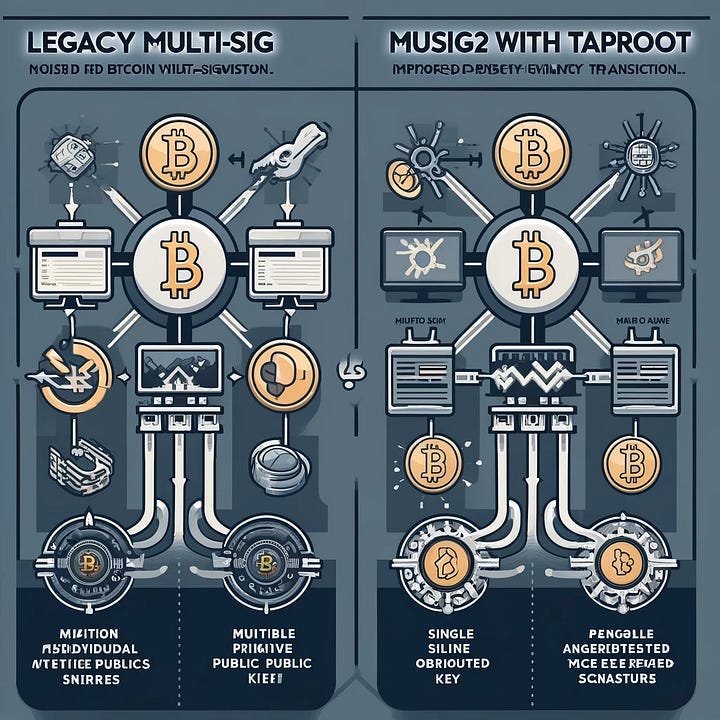
Before Taproot, Bitcoin relied exclusively on ECDSA, which lacks the linear properties needed for key and signature aggregation. Traditional multi-signature implementations using OP_CHECKMULTISIG expose all involved public keys and individual signatures in the witness data. This not only increases transaction size but also leaks information about wallet structure and access policies—compromising privacy and scalability.
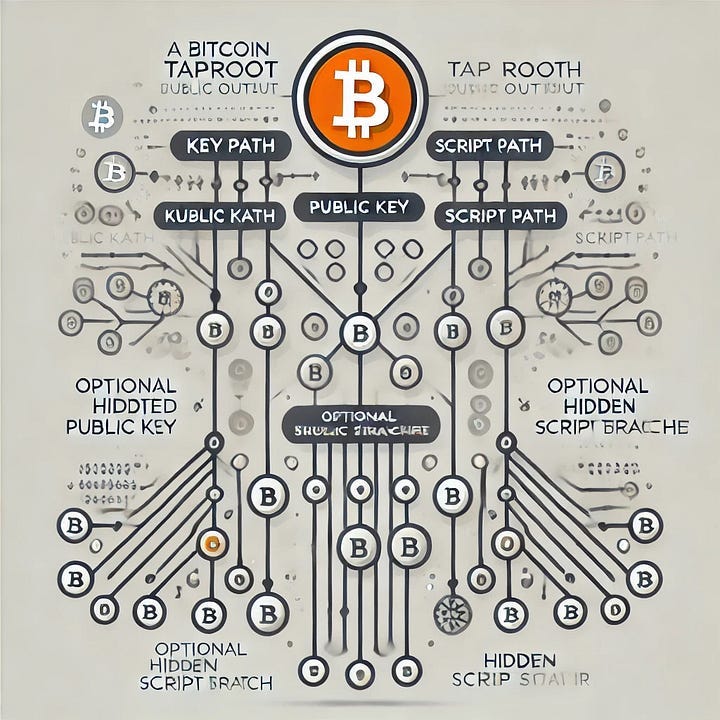
Taproot replaces the legacy P2PKH and P2SH-based spending templates with a new SegWit version 1 output type (P2TR), where the spending condition can be satisfied by:
A key path: A single aggregated Schnorr public key.
A script path: A Merkle root of scripts revealed only when necessary.
Schnorr’s key linearity permits native aggregation: multiple participants can collaboratively produce a single signature that is valid for an aggregated public key. This is the foundation upon which MuSig2 is built.
3. MuSig2: Protocol-Level Breakdown
MuSig2 is a multi-signature scheme designed to aggregate both public keys and signatures using Schnorr cryptography. It is an improvement over MuSig1, offering reduced interactivity while maintaining strong security properties. It is currently under standardization as BIP327 and is already being deployed in systems like Fedimint and considered for future use in the Lightning Network.
3.1 Participants and Inputs
Each participant in a MuSig2 signing session holds:
A private key
xᵢA corresponding public key
Xᵢ = xᵢ·G
The participants aim to collaboratively produce:
A single aggregated public key
XA single Schnorr signature
(R, s)for a given messagem
3.2 Key Aggregation
To prevent rogue-key attacks where a participant might craft a malicious key to cancel others, MuSig2 uses deterministic key coefficients.
First, the system computes a hash of all public keys involved:
Compute
L = H(X₁ || X₂ || ... || Xₙ)
Then, for each signer, derive a coefficient:
Compute
aᵢ = H(L || Xᵢ)
Using these coefficients, the group computes the final aggregated public key:
X = a₁·X₁ + a₂·X₂ + ... + aₙ·Xₙ
This single key X will be used to verify the final Schnorr signature and can be embedded as a Taproot internal key.
3.3 Nonce Generation
Each signer generates at least one secret nonce rᵢ and its corresponding public nonce Rᵢ = rᵢ·G. These nonces must be generated securely to avoid key leakage, either using:
High-entropy randomness from a secure source
Or deterministic methods incorporating the private key, auxiliary data, and message hash
In adversarial or asynchronous signing sessions, an optional commitment scheme can be used:
First, each signer shares a commitment to their nonce, such as
H(Rᵢ)After all commitments are received, they reveal the actual
Rᵢ
This prevents malicious nonce manipulation or biasing attacks.
3.4 Signature Construction
Once all nonces are revealed, they are combined:
Aggregate Nonce:
R = R₁ + R₂ + ... + Rₙ
2. Challenge Hash:
e = H(R || X || m)
3. Partial Signature by Each Signer:
sᵢ = rᵢ + e·aᵢ·xᵢ
Each signer’s partial signature can be individually verified using their public nonce and public key:
sᵢ·G = Rᵢ + e·aᵢ·Xᵢ
3.5 Final Signature Aggregation
Once all partial signatures are collected:
Compute
s = s₁ + s₂ + ... + sₙThe final MuSig2 Schnorr signature is
(R, s)
This is a valid BIP340 Schnorr signature under the aggregated key X, meaning:
s·G = R + e·X
This aggregated signature is indistinguishable from one produced by a single signer, enabling MuSig2 to fully leverage Taproot’s key-path spend model.
4. Taproot Integration
In a Taproot output, the aggregated MuSig2 public key X is directly embedded as the internal key. The resulting output script is:
scriptPubKey: OP_1 || X
When spending from this output via the key path, the transaction includes only:
A 64-byte Schnorr signature
No scripts, no redeem scripts, and no indication that multiple signers were involved. This results in optimal efficiency and maximal privacy.
5. Benefits of MuSig2 with Taproot
Scalability:
The witness size remains constant regardless of the number of signers. Only one aggregated public key and one aggregated signature are included, greatly reducing block space usage compared to legacy OP_CHECKMULTISIG.
Privacy:
There is no on-chain indication that multiple signers participated. The spend appears identical to a single-user Taproot key-path spend.
Security:
MuSig2 protects against rogue key attacks through deterministic coefficient derivation. It also supports optional nonce commitments to protect against nonce tampering.
Efficiency:
The protocol minimizes the number of communication rounds compared to MuSig1, making it practical for hardware wallets and stateless signers.
Flexibility:
MuSig2 works seamlessly with Taproot. Script path fallbacks can still be included if necessary, allowing a hybrid approach where key-path spends are preferred and scripts are used only in exceptional cases.
6. Real-World Applications
Fedimint (Federated Custody):
MuSig2 allows a federation to collectively manage funds via a single Taproot key. Participants cooperatively sign to release funds, and the on-chain footprint is indistinguishable from a single user.
Lightning Network (Future Integration):
In Lightning channels, MuSig2 reduces the cost of opening and closing channels by shrinking transaction size. It also obfuscates the fact that multiple parties are involved.
Collaborative Wallets:
In multi-sig wallet setups with co-signers or recovery keys, MuSig2 improves user privacy and reduces fees. Wallets like Specter, Casa, or Unchained could benefit from this structure.
Cold Storage Solutions:
For secure cold storage with multiple air-gapped devices, MuSig2 enables shared control without exposing key details or using on-chain scripts.
Threshold Schemes (Future):
While MuSig2 is inherently n-of-n, combining it with threshold schemes like FROST enables m-of-n setups with similar benefits.
7. When to Use MuSig2 with Taproot
Recommended Use Cases:
When all signers can be online and responsive at signing time.
When privacy and block space efficiency are priorities.
When the access control model is n-of-n (or threshold with FROST).
For institutions, federations, and co-signing services requiring shared custody.
For users who want collaborative control without revealing wallet structure.
Avoid or Use with Caution If:
You require fallback paths (e.g., time-locked recovery or hashlocks).
You need non-interactive recovery conditions (script-path is preferable).
You require m-of-n threshold logic and cannot use FROST or similar schemes.
You expect unreliable signer availability and cannot guarantee key-path spending.
Conclusion
MuSig2, when combined with Taproot, offers a cryptographically elegant and operationally efficient solution for multi-signature coordination in Bitcoin. It eliminates the traditional trade-offs between privacy, scalability, and security — delivering all three.
Whether deployed in collaborative wallets, federated custody, Lightning channels, or advanced cold storage architectures, MuSig2 sets a new standard for how Bitcoin can support expressive, yet minimal, multi-party control.
As the Bitcoin protocol continues to evolve, MuSig2 represents the next step forward in minimizing trust while maximizing user sovereignty and network efficiency.
You can sign up to receive emails each time I publish.
Link to the original Bitcoin White Paper: White Paper:
Dollar-Cost-Average Bitcoin ($10 Free Bitcoin): DCA-SWAN
Access to our high-net-worth Bitcoin investor technical services is available now: cccCloud
“This content is intended solely for informational use. It is not a substitute for professional financial or legal counsel. We cannot guarantee the accuracy of the information, so we recommend consulting with a qualified financial advisor before making any substantial financial commitments.