
From Bonds to Bitcoin: Rethinking Safe Haven Assets in the Digital Age
How Bitcoin-Linked Treasury Bonds and Decoupling Market Dynamics Are Redefining the Future of Sovereign Finance

Introduction
Traditional fixed-income securities like government bonds have long been cornerstones of institutional finance, praised for their stability and predictability. In contrast, Bitcoin, born out of the 2008 financial crisis, has emerged as a non-sovereign, deflationary digital asset that operates outside conventional monetary policy frameworks. With proposals now surfacing that intertwine both instruments — such as Bitcoin-linked Treasury bonds — their comparison is no longer purely academic. It is imperative for financial and technical professionals alike to understand their respective value propositions, risk profiles, and long-term implications.
1. The Financial Mechanics of Bonds vs Bitcoin
1.1 Bonds: A Traditional Risk-Off Asset
Government and corporate bonds are debt instruments that pay periodic interest and return principal upon maturity. Their valuation is sensitive to interest rate movements, inflation expectations, and credit risk.
Yield Dynamics: Bond yields move inversely to price. Rising interest rates, as seen in recent U.S. Federal Reserve tightening cycles, reduce bond prices but offer higher coupon payments for new issuances.
Inflation Impact: Bonds are inflation-negative assets. Real return diminishes with rising Consumer Price Index (CPI) unless indexed (e.g., TIPS).
Duration Risk: Longer maturities exhibit higher sensitivity to rate changes (modified duration), leading to convexity challenges in portfolio construction.
1.2 Bitcoin: A Decentralized, Volatile Asset
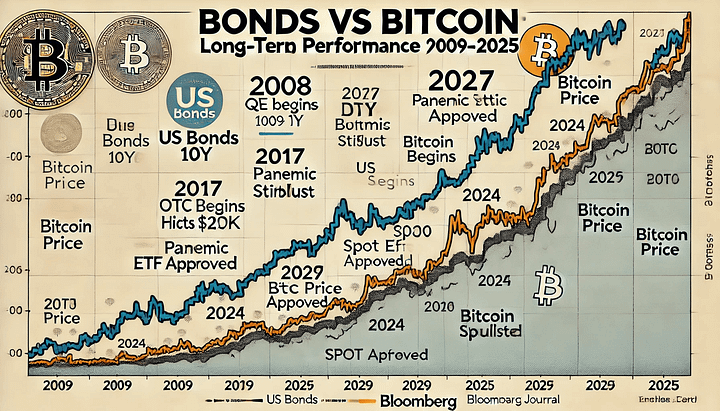
Bitcoin operates under a fixed-supply, proof-of-work consensus model. It is not a yield-bearing instrument in the traditional sense but has appreciated significantly in USD terms since inception.
Supply Hard Cap: Bitcoin’s monetary policy is algorithmically defined. Only 21 million BTC will ever exist, enforced through consensus and difficulty adjustments.
Block Subsidy Halvings: Bitcoin issuance rate drops every 210,000 blocks (~4 years), decreasing miner incentives and reinforcing scarcity.
Volatility and Liquidity: Bitcoin remains highly volatile compared to bonds, but liquidity has increased across both spot and derivatives markets.
2. Bitcoin-Linked Treasury Bonds: Hybrid Instruments
Pierre Rochard, CEO of The Bitcoin Bond Company, has proposed a novel framework: Bitcoin-linked Treasury bonds, where 90% of proceeds fund standard government obligations and 10% are used to acquire Bitcoin for sovereign reserves.
2.1 Structural Design and Budget Neutrality
Cash Flow Mechanics: Similar to conventional bonds, these instruments could offer fixed or variable coupons but embed optionality through BTC exposure.
Budget Neutrality: By allocating a fraction of proceeds to Bitcoin, the government could potentially benefit from long-term capital appreciation, offsetting interest costs — a hedge against fiat debasement.
2.2 Strategic Reserve Theory
Bitcoin accumulation through sovereign bonds introduces a new macro-strategic consideration: using BTC as a geopolitical reserve asset. Similar to gold in Bretton Woods, Bitcoin could offer:
Neutral Settlement Layer: Censorship resistance and final settlement without reliance on SWIFT or FX markets.
Digital Gold Dynamics: Non-liability asset class with thermodynamic cost to production and resistance to dilution.
3. Market Behavior: Divergence in Risk Perception
3.1 Macro Decoupling Evidence
Recent financial turbulence, including rising bond yields and equity drawdowns, did not provoke significant volatility in Bitcoin markets — a contrast to prior years.
2022 vs. 2024–2025 Patterns: Historically, rising yields crushed risk assets, including Bitcoin. Now, BTC demonstrates muted correlation, potentially indicating a shift in investor perception — from speculative asset to digital store of value.
Institutional Flows and Demand Elasticity: Increased ETF participation and custody solutions (e.g., Fidelity, BlackRock) may buffer price against macro shocks.
3.2 Bond Yields and Crypto Sentiment
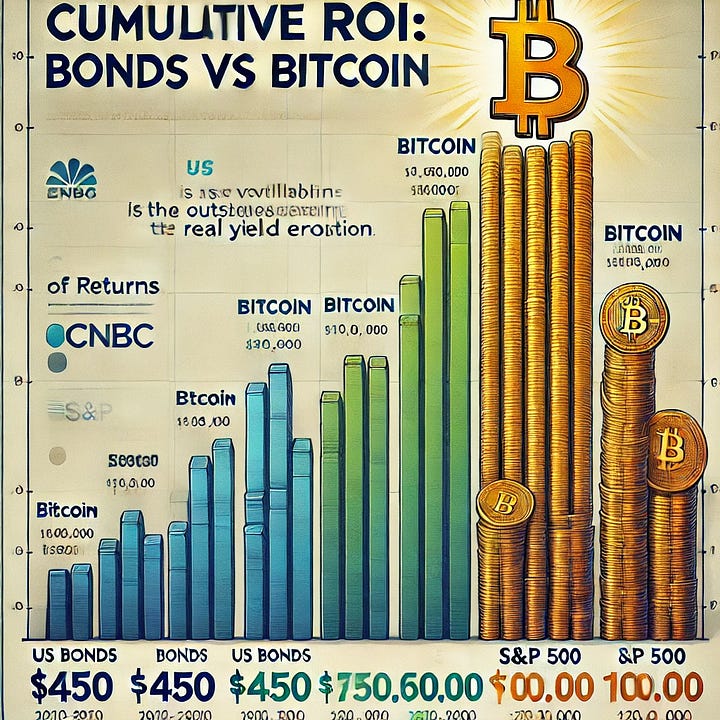
Despite growing independence, bond yields still influence crypto indirectly via:
Risk Appetite: High yields attract capital away from speculative assets.
Liquidity Conditions: QT (Quantitative Tightening) reduces capital availability for alternative investments like Bitcoin.
4. Protocol and Custody Considerations
4.1 Bitcoin Protocol Design: Immutable and Auditable
For any government considering Bitcoin-linked bonds or reserves, it is crucial to understand protocol-level guarantees:
Auditability: The Bitcoin UTXO set can be cryptographically verified; holdings are transparently auditable.
Censorship Resistance: Transactions can be broadcast via satellites (e.g., Blockstream Satellite Pro Kit) or mesh networks — ideal for resilient reserve systems.
Non-Custodial Storage: Governments could hold BTC in multisig configurations, using Shamir’s Secret Sharing or collaborative custody with regulated partners.
4.2 Bonds: Custody Through Intermediaries
Custodian Risk: Bonds are typically held through brokers or custodians, introducing systemic risks.
Default Risk: While U.S. Treasuries are considered “risk-free,” they carry inflation and political risks that Bitcoin, as a bearer asset, circumvents.
5. Institutional and Governmental Adoption: Philosophical Tensions
5.1 Is Government Adoption a Threat to Bitcoin?
Early Bitcoiners might view state adoption as antithetical to cypherpunk ethos. However, Rochard argues this signals Bitcoin’s triumph, not compromise:
“Bitcoin is not being co-opted by governments — governments are being changed by Bitcoin.”
5.2 Privateers vs Pirates: Byron Gilliam’s Framework
Drawing from Gilliam’s “The Mixed Blessing of Institutional Adoption,” the parallel between financial pirates (free actors) and privateers (state-aligned actors) is instructive. State involvement can bring legitimacy — but also surveillance and regulatory capture.
Conclusion: A Tale of Divergence, Not Competition
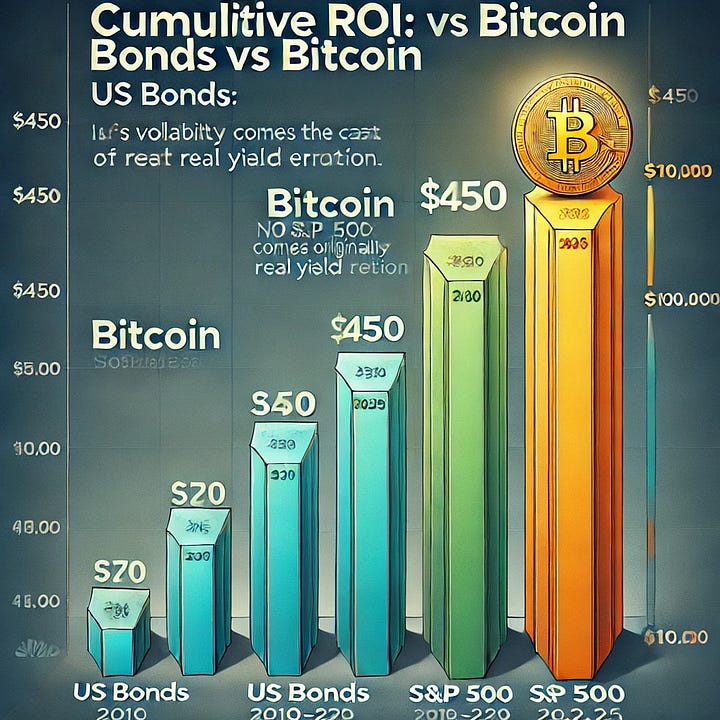
At first glance, bonds and Bitcoin appear to occupy different universes: one rooted in centuries-old sovereign debt instruments, the other born from cryptographic primitives and distributed consensus. But their juxtaposition reveals more than contrast — it exposes a fundamental divergence in how value, trust, and monetary energy are stored and transferred in the 21st century.
Bonds: Yield-Bearing Claims on a Debt-Based System
Bonds function as contractual claims on future cash flows, reliant on the creditworthiness of the issuer — typically a government or corporation. But that guarantee comes with increasing fragility. The long-term real yield of sovereign debt, especially U.S. Treasuries, has been in secular decline since the 1980s. The recent macro cycle has exposed their vulnerability to both inflation and rate volatility.
Even “risk-free” assets now carry:
Negative real returns when adjusted for CPI and monetary debasement.
Reinvestment risk under uncertain rate regimes.
Custodial and counterparty risk, as holdings are intermediated and legally entangled.
While bonds remain useful for liquidity management, capital preservation, and regulatory compliance, they are no longer viable as long-duration stores of wealth in a world of expanding monetary base and fiscal instability.
Bitcoin: A Non-Liability, Protocol-Enforced Monetary Asset
Bitcoin stands in contrast as a non-debt, non-custodial, bearer asset with:
Deterministic supply issuance defined by BIP consensus and enforced by network nodes.
Decentralized validation of ownership via UTXO and digital signatures (ECDSA/Schnorr).
Self-custody primitives using HD wallets (BIP 32/44), multisig schemes (BIP 11/45), and secure key management.
Thermodynamic backing via proof-of-work, quantifying economic cost and making issuance politically neutral and censorship resistant.
Bitcoin’s volatility is often mistaken for risk, but technically, it’s the emergent price discovery function of a new monetary network bootstrapping liquidity and credibility without centralized trust.
In fact, Bitcoin’s long-term value proposition derives directly from:
Protocol-level guarantees, not political ones.
Cryptographic assurances, not rating agency opinions.
Hard-coded monetary policy, not discretionary central banking.
Sovereign-Grade Reserves Require Sovereign-Grade Assets
Pierre Rochard’s proposal for Bitcoin-linked Treasury bonds is not just a financial product innovation — it’s a macro hedge wrapped in a debt instrument. By allocating even a small percentage of bond proceeds toward Bitcoin accumulation, governments can:
Hedge against the long-term erosion of fiat credibility.
Tap into an emerging global neutral reserve asset.
Incentivize bond uptake from crypto-native capital allocators.
This isn’t about replacing bonds with Bitcoin. It’s about recognizing that in a multi-polar, de-dollarizing world, the long tail of monetary entropy is accelerating. Bitcoin is not a high-beta risk asset — it’s a globally permissionless monetary battery that turns thermodynamic work into incorruptible scarcity.
So, while bonds may continue to serve legacy financial infrastructure, Bitcoin is laying the groundwork for the infrastructure of the next monetary epoch. One where monetary trust is no longer borrowed — it’s verified at every block, by every node, with no permission required.
For more advanced discussion on Bitcoin custody, HD wallets, multisig key management, or setting up sovereign-grade infrastructure like Blockstream Satellite and Chaumian mints, feel free to dive deeper with cccCloud LLC.
You can sign up to receive emails each time I publish.
Link to the original Bitcoin White Paper: White Paper:
Dollar-Cost-Average Bitcoin ($10 Free Bitcoin): DCA-SWAN
Access to our high-net-worth Bitcoin investor technical services is available now: cccCloud
“This content is intended solely for informational use. It is not a substitute for professional financial or legal counsel. Accuracy of the information is not guaranteed; therefore, it is advisable to consult with a qualified financial advisor before making any substantial financial commitments.”