
Cracking the Bitcoin Slot Machine: Why Brute-Forcing Seed Phrases is a Fool's Game
Exploring the mechanics behind random mnemonic generators, the power of BIP39, and why even a 12-word seed phrase is more secure than your wildest odds.

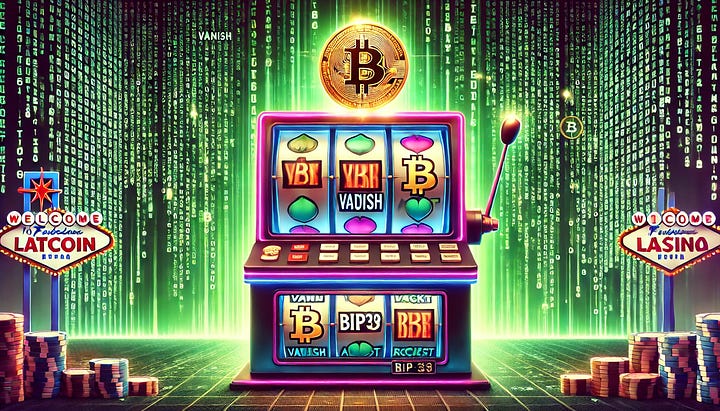
Inside the Bitcoin Slot Machine: How Mnemonic “Treasure Hunting” Sites Actually Work
There’s a curious little website floating around at https://coinables.github.io/mnemonic-slots, claiming to offer a “slot machine” that spins up random 12-word Bitcoin seed phrases and checks them for balances. While the interface makes it look like a game of chance, what it’s really doing is providing a live demo of just how astronomically improbable it is to stumble upon a funded Bitcoin wallet.
Let’s break down how this tool works under the hood — from mnemonic generation to balance checks — and why it’s best viewed as a novelty rather than a serious hunting tool.
1. Mnemonic Generation via BIP39
The foundation of the site is BIP39 — the standard that maps a 12-word human-readable phrase to 128 bits of entropy plus a 4-bit checksum. The total space of possible 12-word phrases is ²¹²⁸, or roughly 3.4 × 1⁰³⁸—a number so massive that even scanning a billion mnemonics per second wouldn’t yield a single match within the lifetime of the universe.
The site uses JavaScript to randomly select 12 words from the official BIP39 English wordlist. This happens entirely in the browser, ensuring everything is client-side:
const bip39 = require('bip39');
const mnemonic = bip39.generateMnemonic();  // Random 12-word phrase
Once the mnemonic is generated, it’s turned into a 512-bit seed using PBKDF2-HMAC-SHA512:
const seed = bip39.mnemonicToSeedSync(mnemonic);2. Deriving the Wallet: BIP32 and BIP44
From that 512-bit seed, the next step is deriving a master key using BIP32, which defines hierarchical deterministic (HD) wallets. The root extended key can then be used to derive any number of child keys using hardened and non-hardened paths.
For compatibility with standard Bitcoin wallets, the site follows BIP44, which defines the path:
m / 44' / 0' / 0' / 0 / 0This corresponds to:
Purpose: 44' (BIP44)
Coin type: 0' (Bitcoin mainnet)
Account: 0'
Change: 0 (external addresses)
Address index: 0
In code:
const bip32 = require('bip32');
const root = bip32.fromSeed(seed);
const child = root.derivePath("m/44'/0'/0'/0/0");
The derived child key contains both a private and public key. The site uses the public key to generate a P2PKH address:
const bitcoin = require('bitcoinjs-lib');
const { address } = bitcoin.payments.p2pkh({ pubkey: child.publicKey });
This is your familiar Base58Check address starting with 1.
3. Querying the Balance
Once the address is derived, the site performs a balance check using a public Bitcoin API — typically an Esplora-compatible endpoint like Blockstream’s:
GET https://blockstream.info/api/address/1ExampleAddressThis returns data including:
{
  "chain_stats": {
    "funded_txo_sum": 5000000000,
    "spent_txo_sum": 0
  }
}
Subtracting the spent outputs from the funded outputs gives the live balance for the address.
In most cases, of course, this value will be zero — and that’s the entire point.
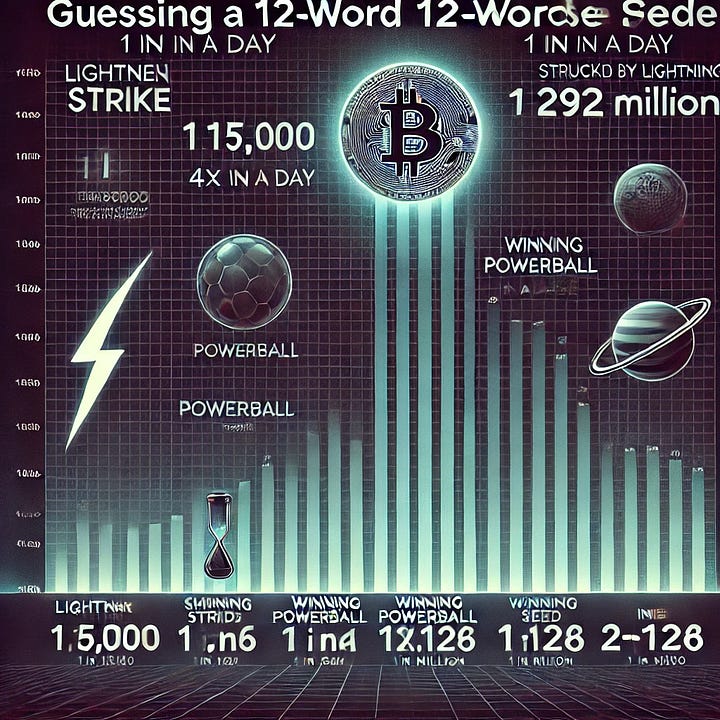
Odds of Success: Zero with Style
This site isn’t about realistically “finding” Bitcoin. It’s a vivid demonstration of why Bitcoin’s security model works: the sheer size of the keyspace makes brute-forcing a private key infeasible.
Consider:
²¹²⁸ possible 12-word mnemonics
Even scanning 1 billion mnemonics per second, 24/7, you’d barely dent the space
You’d need a billion Earths running for billions of years to have a remote shot at finding a funded address
It’s like picking a grain of sand from all the beaches on Earth… blindfolded… and hoping it’s the right one. Twice.
Is It Safe?
From a technical standpoint, the site is not malicious if run from a trusted source like GitHub Pages and viewed over HTTPS. All computation occurs in the browser, and the generated seed never leaves your device — unless you explicitly export or use it.
However, do not use this site to generate seed phrases for actual wallets. The code could be modified or intercepted in the future. For secure wallet generation, always use air-gapped, open-source tools with deterministic builds (e.g., bitcoin-wallet, SeedSigner, Sparrow, or Specter).

Conclusion: A Novelty with Educational Value
The mnemonic slots site is a fun toy — but that’s all it is. It’s a gamified visualization of just how impenetrable Bitcoin’s cryptographic architecture is. If you do hit a non-zero balance? You’ve just witnessed a once-in-the-history-of-humanity fluke. But don’t hold your breath.
If you want to experiment further, you can clone the site’s code and inspect or modify it locally. Or, if you’re serious about Bitcoin key generation and wallet construction, dive deeper into the BIP32/39/44 stack and start working with your own code.
Need a sample script to replicate this functionality locally or explore derivation paths (including BIP84 for native SegWit)? Let me know —I’ve got the goods.
Postscript: Just How Impossible Are the Odds?
Let’s get real for a second. The odds of landing on a valid, funded Bitcoin address using this mnemonic slot machine are not just bad—they’re cosmically absurd. To put that into perspective, here’s how the math stacks up against real-world phenomena:
The annual odds of being struck are about 1 in 1.2 million, which compound over a lifetime to give the 1-in-15,300 estimate.
Struck by lightning four times in one day? About 1 in 10²⁴
Winning the Powerball jackpot? Roughly 1 in 292 million
Randomly guessing a funded 12-word seed?
1 in ²¹²⁸—that’s ~1 in 340,282,366,920,938,463,463,374,607,431,768,211,456
To put that number in human terms:
If every grain of sand on Earth (~7.5 x 10¹⁸) was a seed phrase,
You’d still need to search trillions of Earths to have a sliver of a chance.It’s like finding a single atom in the entire observable universe.
Or flipping a coin 128 times and getting heads every single time.
Even if you had a hypothetical supercomputer capable of checking a billion seeds per second, 24/7, for a billion years, you wouldn’t get close.
TL;DR?
You are more likely to spontaneously evolve into a sentient potato than to hit a funded address using this site.
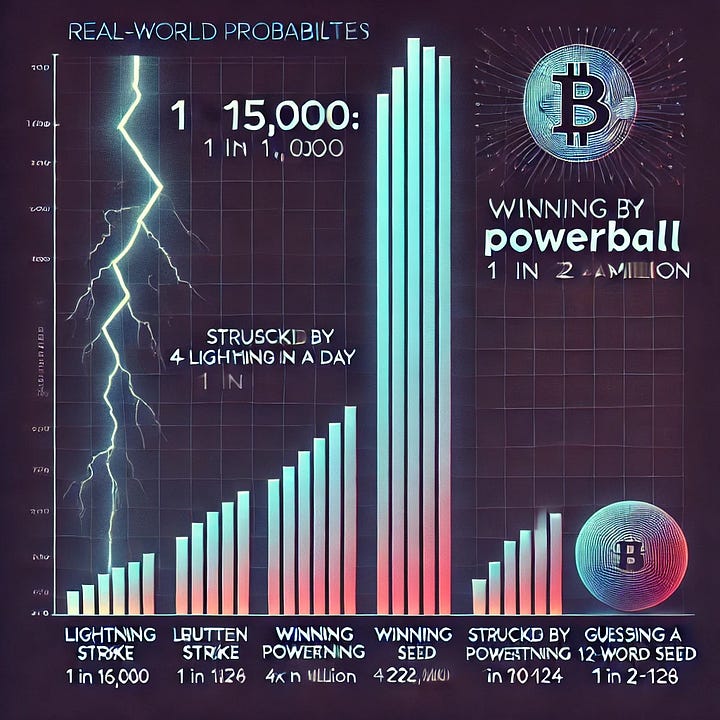
And Here’s the Key Takeaway
Even a 12-word seed phrase is cryptographically secure when generated properly using BIP39. That 128-bit entropy space is large enough to protect your Bitcoin from brute-force attacks for all practical purposes.
Now consider the 24-word seed: that’s 256 bits of entropy — a number so vast it makes 128 bits look cozy. The number of possible 24-word mnemonics is so large that it’s not even worth comparing to known universal constants anymore. It’s effectively infinite from the standpoint of computational feasibility.
This is what makes Bitcoin’s security model so elegant: your private keys are protected not by secrecy but by math — the kind of math that simply doesn’t lose.
So while the mnemonic slot site makes for a great cryptographic horror story or an educational demo, it also serves as a reassuring reminder: If you’ve generated your seed phrase securely and stored it safely, your Bitcoin is beyond reach — even from the gods of brute force.
You can sign up to receive emails each time I publish.
Link to the original Bitcoin White Paper: White Paper:
Become a Medium member… Stories from MP Di Fulvio: Membership:
Dollar-Cost-Average Bitcoin ($10 Free Bitcoin): DCA-SWAN
Access to our high-net-worth Bitcoin investor technical services is available now: cccCloud
“This content is intended solely for informational use. It is not a substitute for professional financial or legal counsel. Accuracy of the information is not guaranteed; therefore, it is advisable to consult with a qualified financial advisor before making any substantial financial commitments.”