
Beyond the Seed: Mastering Bitcoin Wallet Security with BIP-39 Passphrases
Unlocking Deterministic Wallet Layers with Cryptographic Precision and Operational Sovereignty

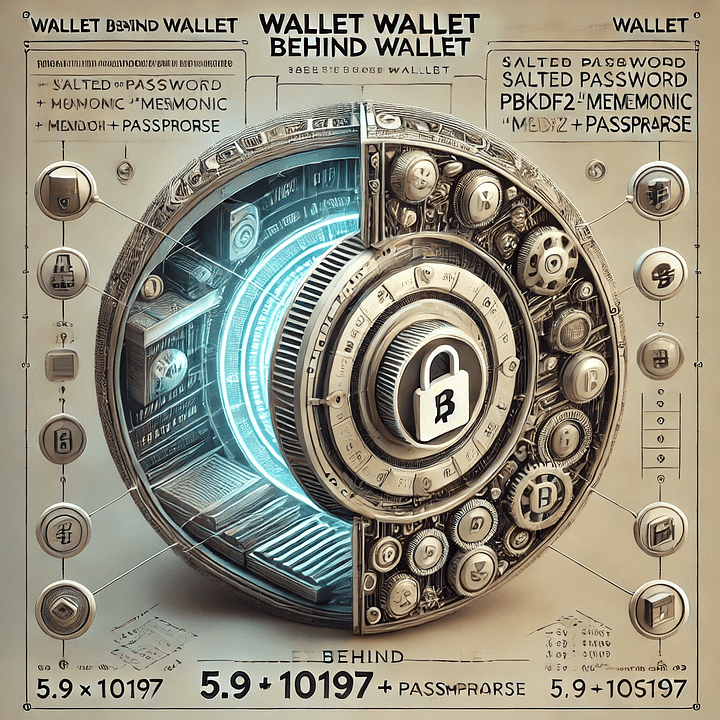
The BIP-39 Passphrase: A Wallet Behind a Wallet
Abstract
In modern Bitcoin custody, seed phrase backups derived from the BIP-39 standard serve as the cornerstone of wallet recoverability. However, BIP-39 includes an optional — yet vastly misunderstood — extension: the passphrase. This “13th” or “25th” word is not just a mnemonic enhancement but a cryptographically significant key-stretching construct. It generates an entirely separate BIP-32 wallet tree when applied to the same mnemonic seed. This article explores the underlying mechanisms, design motivations, historical evolution, and best practices surrounding the BIP-39 passphrase, providing clarity on how and why it should be used to create a “wallet behind a wallet” architecture for maximum security.
1. Background: BIP-39 and the Standard Seed Phrase
1.1. Entropy to Mnemonic: A Recap
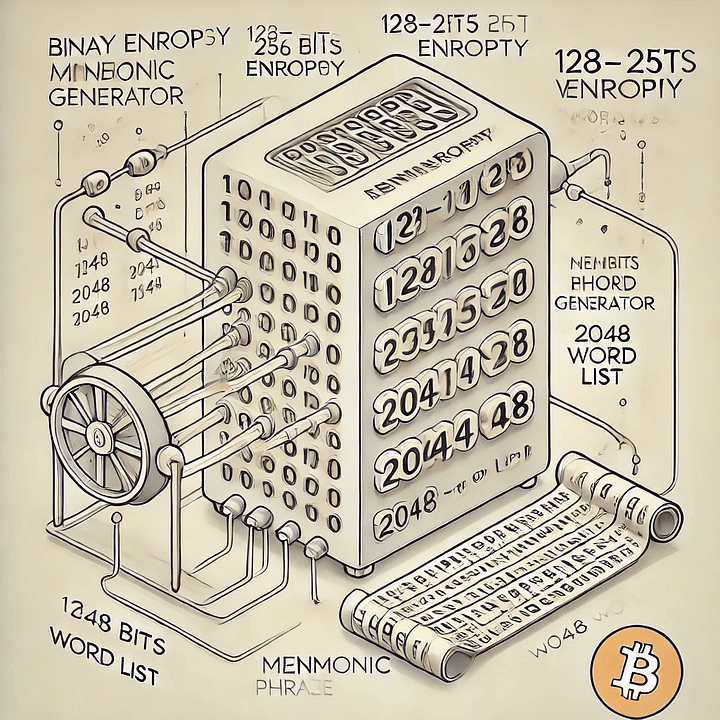
The BIP-39 standard specifies how to convert a fixed amount of entropy (128–256 bits) into a list of easily recordable mnemonic words chosen from a fixed 2048-word list.
The process involves the following transformation:
Input: 128 to 256 bits of entropy.
Output: 12 to 24 mnemonic words + 4 to 8 bits of checksum.
PBKDF2 uses HMAC-SHA512 to derive a seed from these words.
iniseed = PBKDF2(mnemonic, salt="mnemonic" + passphrase, 2048 iterations)The inclusion of the optional passphrase string in the salt component introduces a second dimension of derivation. Thus, the passphrase effectively defines a secondary layer of authentication, resulting in a fundamentally different seed value and, by extension, an entirely different BIP-32 wallet.
2. BIP-39 Passphrase as Cryptographic Defense
2.1. Wallet Isolation via Passphrase
The BIP-39 passphrase is not a cosmetic or UI-level feature. It acts as a key derivation hardening function. Any change to the passphrase (even a single character) leads to the derivation of an entirely different master private key and address hierarchy.
This creates:
Wallet determinism: Each passphrase deterministically maps to one wallet.
Wallet independence: No correlation or shared private key material exists between wallets derived from the same mnemonic but different passphrases.
Unlimited derivations: There are 256^N possible wallets for an N-character ASCII passphrase—approximately 5.9 × 10¹⁹⁷ permutations when N=100 (the maximum allowed by COLDCARD).: There are 256^N possible wallets for an N-character ASCII passphrase—approximately 5.9 × 10¹⁹⁷ permutations when N=100 (the maximum allowed by COLDCARD).
2.2. Cryptographic Implications
From a security standpoint, the passphrase performs two critical functions:
Reduces seed exposure: Even if someone gets the BIP-39 mnemonic, they still can't access the funds in wallets protected by unknown passphrases without trying every possible combination, which is nearly impossible for complex phrases. If someone gets the BIP-39 mnemonic, they still can't get to the money in wallets protected by unknown passphrases without trying every possible combination, which is almost impossible for complicated phrases.
Creates decoy wallets: By using several passphrases on purpose (some with money and some without), users can set up a way to deny ownership that is similar to Shamir’s Secret Sharing or duress PINs, but without having to rely on third-party storage or complex systems. By intentionally using multiple passphrases (some with funds, others without), users can implement a plausible deniability scheme akin to Shamir’s Secret Sharing or duress PINs, but without needing to trust third-party custody or threshold systems.
3. Historical Motivation and BIP-39 vs. BIP-32
3.1. BIP-32: Tree Structure Without Mnemonics
Before BIP-39, BIP-32 (Hierarchical Deterministic Wallets) introduced the idea of a deterministic key tree, enabling wallet software to derive an entire key hierarchy from a single master seed (m). While powerful, BIP-32 lacked human-readable backup options.
BIP-39 was introduced later to solve that problem by providing a human-friendly mnemonic representation of the seed. However, the addition of the passphrase was a deliberate improvement: a way to bind an additional secret to the wallet without changing the underlying BIP-32 logic.
3.2. The Salt as a Binding Mechanism
The passphrase enters the key derivation function not as part of the entropy but as part of the salt:
inisalt = "mnemonic" + passphraseThis ensures that even with the exact same mnemonic phrase, two users (or one user using two different passphrases) will derive distinct seeds and hence distinct BIP-32 master keys.
4. Practical Use: COLDCARD Implementation
4.1. Stateless Security
COLDCARD does not store passphrases internally. Every time a passphrase is used, the wallet must derive the master key from scratch using:
The secure element stores the 24-word seed.
You can manually enter the passphrase or use the MicroSD/command line.
The result is a deterministic wallet with a unique Extended Fingerprint (XFP). Record this XFP, a shortened identifier of the master key, to ensure you enter the correct passphrase in future sessions.
4.2. Workflow Example
Assume you create a wallet with seed phrase:
iniseed = mnemonic("blame relief cat swing ...")And passphrase:
inipassphrase = "vault123!"This generates:
iniseed_bytes = PBKDF2(mnemonic, salt="mnemonicvault123!", 2048)And the master BIP-32 key:
inixprv = BIP32MasterKey(seed_bytes)If you enter "Vault123!" (capital V), you derive a completely different xprvand corresponding wallet, even though the mnemonic is the same. That subtle typo would yield an empty wallet and could cause fund loss if the user is unaware.

5. Storage and Backup Considerations
5.1. Importance of Recording the XFP
The only way to validate that a passphrase was entered correctly is to compare the resulting XFP with a recorded reference. Failure to do so may result in irreversible access loss due to the indistinguishability of “wrong passphrase” from “empty wallet.”
5.2. Secure Backup of Passphrases
Passphrases can be stored on encrypted MicroSD cards via COLDCARD. The storage method uses AES-256 in CTR mode, with the encryption key tied to the card’s unique serial number and the BIP-39 seed. This feature makes the file undecryptable if copied elsewhere.
Never rely solely on memory or insecure digital storage (e.g., plaintext notes or cloud sync). Instead:
Store your mnemonic and passphrase separately in physically secure locations.
Use metal backups for durability.
Use Shamir’s Secret Sharing or multisig setups if additional redundancy is needed.
6. Locking Down the Seed
6.1. Optional Finalization
Once a desired wallet and passphrase are established, COLDCARD offers a Lock Down Seed feature that irreversibly converts the BIP-39-based wallet into a pure BIP-32 wallet.
This operation:
Computes the XPRV using the mnemonic and passphrase.
It eliminates the seed words and passphrase.
Stores the resulting master key as the root identity inside the secure element.
This is particularly valuable when issuing devices to third parties (e.g., trustees or family members) without exposing the original mnemonic.
7. Use Cases for BIP-39 Passphrases
Plausible Deniability: Use benign decoy wallets with simple passphrases.
Multi-person Delegation: Seed + different passphrases allow for unique wallets on each device without sharing root entropy.
Operational Compartmentalization: Separate savings, spending, and lightning accounts, each protected by different passphrases.
Backup Obfuscation: Store mnemonics in visible locations and keep passphrases elsewhere, rendering backups inert to attackers.
Conclusion
The BIP-39 passphrase is more than a mere add-on. It’s a deliberate extension of the Bitcoin security model, offering deterministic wallet branching, privacy, and resistance to physical compromise. When used correctly — especially with proper XFP management and secure backups — it turns a single seed into a virtually unlimited vault structure, each layer protected by a cryptographic secret known only to the user. Like onion layers of sovereignty, passphrases extend the functionality of HD wallets into a realm of tailored, purpose-built privacy.
Your wallet is not just your keys. It’s your keys plus your secrets — and the passphrase is the most powerful secret of them all.
You can sign up to receive emails each time I publish.
Link to the original Bitcoin White Paper: White Paper:
Dollar-Cost-Average Bitcoin ($10 Free Bitcoin): DCA-SWAN
Access to our high-net-worth Bitcoin investor technical services is available now: cccCloud
“This content is intended solely for informational use. It is not a substitute for professional financial or legal counsel. We cannot guarantee the accuracy of the information, so we recommend consulting with a qualified financial advisor before making any substantial financial commitments.