
Alan Turing and Artificial Intelligence: The Question That Became Our Future
Long before large language models, GPUs, cloud platforms, and synthetic media, Alan Mathison Turing asked whether machines could imitate thought—and the AI age is now forcing civilization to answer.

Part 2 — Why Turing Matters More in the AI Age, Not Less
Alan Mathison Turing belongs to computer history.
But he does not belong only to computer history.
He belongs to the present.
In fact, Turing may be more relevant today than at any time since his death. That may sound strange at first. We now live in a world of cloud computing, GPUs, neural networks, large language models, autonomous agents, cryptographic systems, distributed protocols, global data centers, and AI systems capable of writing code, generating images, analyzing documents, and carrying on convincing human conversation.
The machinery has advanced far beyond anything Turing physically possessed.
But the questions have not moved beyond him.
They have moved toward him.
Can machines compute?
Can machines simulate other machines?
Can machines manipulate symbols?
Can machines imitate human reasoning?
Can machines produce behavior that appears intelligent?
Can machine output be trusted?
Can a system be understood if its internal operation becomes too complex for ordinary users to inspect?
What are the limits of computation?
What are the limits of machine intelligence?
These are not new questions.
They are Turing questions.
The AI age is not leaving Alan Turing behind. The AI age is proving that he was standing at the doorway all along.
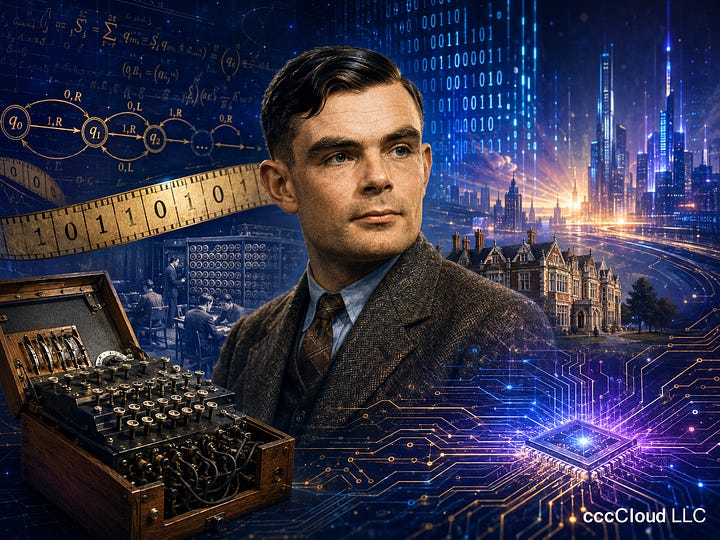
The 1950 Paper That Still Frames the AI Question
In 1950, Turing published one of the most important papers in the history of artificial intelligence:
“Computing Machinery and Intelligence.”
The paper begins with a question that still sits at the center of the modern world:
Can machines think?
That question appears simple only on the surface.
Turing understood immediately that it could become trapped in philosophy, religion, emotion, and word games. What does “think” mean? What does “machine” mean? Does intelligence require consciousness? Does language require understanding? Does reasoning require a soul? Does imitation count? Is intelligence an internal state, an external behavior, or some combination of both?
Turing did something brilliant.
He reframed the problem.
Instead of trying to define “thinking” directly, he proposed a behavioral test. If a human judge communicates through text with both a human and a machine, and the judge cannot reliably distinguish the machine from the human, then the machine has demonstrated a form of intelligent behavior.
This became known as the Turing Test.
The Turing Test is not perfect. It does not prove consciousness. It does not prove wisdom. It does not prove moral judgment. It does not prove human understanding in the full human sense.
But it was a powerful operational move.
Turing shifted the discussion away from mystical debate and toward measurable behavior.
That is how serious engineers think.
That is how computer scientists think.
That is how protocol-level people think.
Do not begin with the marketing label.
Begin with the system.
What input does it receive?
What output does it produce?
What rules govern its behavior?
What can be measured?
What can be repeated?
What can be tested?
What can be attacked?
What can be verified?
Turing did not solve artificial intelligence in 1950.
He did something more important.
He gave civilization a serious framework for asking the question.
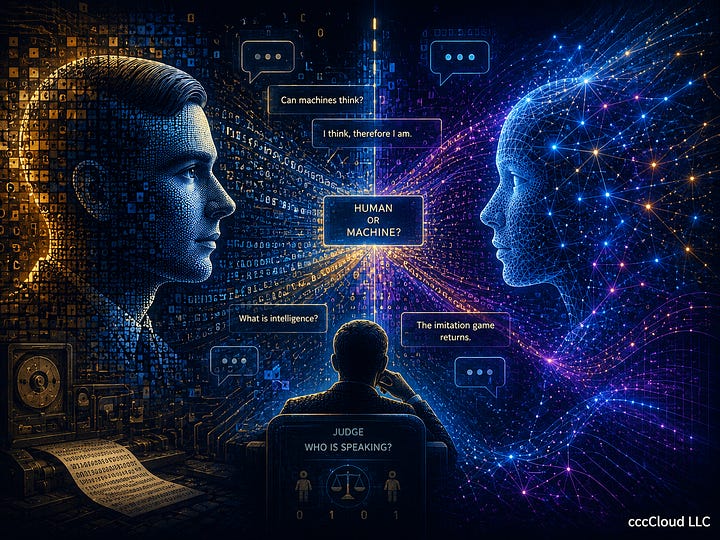
The Turing Test Has Returned as Daily Reality
For decades, the Turing Test felt like a philosophical exercise.
Today it feels like an operational problem.
A modern large language model can write an essay, draft an email, generate software code, summarize legal language, explain medical concepts, translate across languages, create business plans, produce technical documentation, analyze logs, compose poetry, generate research outlines, and carry on long-form conversation.
A user sitting at a keyboard may not always know whether a response came from a human being or from a machine.
That does not mean the machine is human.
It does not mean the machine is conscious.
It does not mean the machine has a soul, moral agency, lived experience, responsibility, or human judgment.
But it does mean Turing’s behavioral question has arrived.
Modern AI systems can imitate many forms of human symbolic output.
They can imitate explanations.
They can imitate expertise.
They can imitate reasoning.
They can imitate creativity.
They can imitate empathy.
They can imitate confidence.
That last one is dangerous.
A machine that imitates knowledge can help civilization.
A machine that imitates certainty can mislead civilization.
This is why Turing’s question matters so much now.
The issue is no longer whether a machine can produce human-like language. That question has already been answered in practical terms. The deeper question is whether human beings can maintain judgment, verification, and responsibility in a world where machine-generated language becomes abundant, persuasive, and cheap.
That is the real AI problem.
Not merely intelligence.
Trust.
AI Is Not Magic — It Is Computation at Scale
The most important thing to say about artificial intelligence is also the most basic:
AI is not magic.
It may feel magical to the casual user. It may produce outputs that appear shockingly human. It may summarize a 100-page document in seconds, generate working software, translate complex ideas, or draft a professional article faster than any human assistant.
But underneath the surface, AI remains computation.
Modern AI systems are built from mathematics, software, data, model architecture, training methods, parameter weights, vector representations, probability distributions, hardware acceleration, memory hierarchy, and inference engines.
At the protocol level, a large language model does not “know” in the human sense.
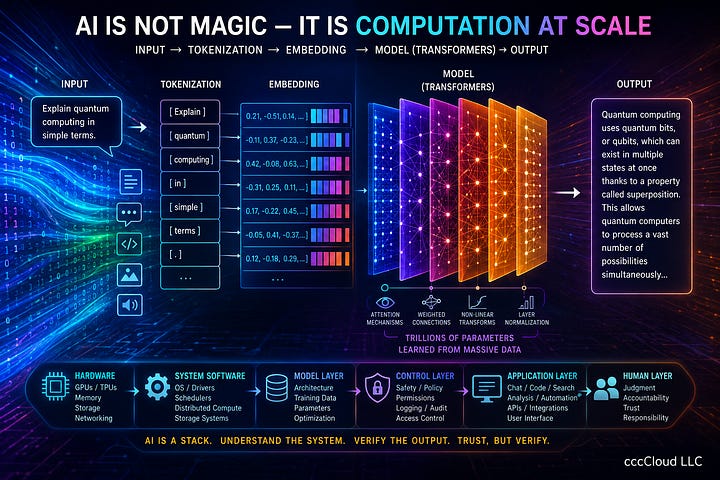
It receives input.
It converts language into tokens.
It maps those tokens into numerical structures.
It processes those structures through trained layers.
It uses learned statistical relationships to generate likely continuations.
It produces output.
The result can be useful. It can be impressive. It can even appear profound.
But the process is still machine computation.
That is where Turing remains essential.
Turing gave us the early intellectual foundation for thinking about machines that manipulate symbols according to rules. Today, those rules may be learned from enormous datasets rather than being handwritten into a small table. The representations may exist inside massive parameter spaces rather than on a simple tape. The machine may run across GPUs in global data centers rather than inside a single electromechanical device.
But the deeper pattern remains:
Input.
State.
Transformation.
Output.
Evaluation.
Iteration.
That is computation.
The machine has grown vast, but it has not escaped its nature.
From Turing Machines to Neural Networks
A Turing machine is explicit, symbolic, and rule-based.
A modern neural network is distributed, statistical, and trained.
They are not the same thing.
But a neural network still runs on computing machinery. It is implemented in software. It executes on digital hardware. It depends on memory, processors, numerical operations, data movement, and deterministic layers of computation underneath the probabilistic behavior seen by the user.
Training a neural network is the process of adjusting parameters so the model better maps inputs to desired outputs.
Inference is the process of using those trained parameters to produce an output from new input.
In large language models, text is broken into tokens. Those tokens are mapped into vectors. Transformer architectures use attention mechanisms to model relationships among tokens across context. The model then generates output by predicting token sequences based on learned statistical structure.
That is a long way from Turing’s abstract tape and read/write head.
But it is still inside Turing’s universe.
The difference is scale, method, and architecture.
Instead of a small rule table, we have billions or trillions of learned parameters.
Instead of a single tape, we have memory hierarchies, vector databases, GPUs, tensor operations, distributed training clusters, and high-speed interconnects.
Instead of manually encoded rules, we have trained statistical behavior.
Instead of simple symbols, we have language, images, code, audio, video, and multimodal representations.
But trained behavior is still machine behavior.
This is the point that must not be lost.
The surface looks human.
The substrate is computational.
Turing understood that the surface would eventually become difficult to judge.
That is why he remains so relevant.
The Protocol-Level View of AI
The average user sees a chatbot.
That is the surface.
A serious technologist sees a stack.
At the bottom is hardware: CPUs, GPUs, TPUs, memory, storage, networking, power, cooling, data centers, and specialized accelerators.
Above that is system software: operating systems, kernels, drivers, schedulers, distributed compute frameworks, storage systems, container layers, orchestration systems, and security boundaries.
Above that is the model layer: architecture, parameters, tokenization, embeddings, attention, context windows, training, fine-tuning, reinforcement learning, inference optimization, retrieval augmentation, and tool use.
Above that is the control layer: system instructions, permissions, safety rules, policy filters, identity management, logging, rate limits, audit systems, and access controls.
Above that is the application layer: chat interfaces, coding assistants, research tools, document analysis, customer support, workflow automation, medical support, financial analysis, education, and security operations.
Above that is the human layer: incentives, misuse, dependency, trust, judgment, accountability, deception, and moral responsibility.
This entire stack is the real AI system.
Not just the model.
Not just the application.
Not just the screen where the user types.
The AI system is hardware, software, data, model behavior, control policy, user behavior, institutional incentives, and operational deployment.
Turing would have understood this instinctively.
His wartime work against Enigma conveyed the same lesson.
Enigma was not merely a cipher machine.
It was a system.
It included rotors, plugboards, settings, operators, procedures, message formats, daily keys, military habits, repeated phrases, captured materials, and human mistakes.
AI is also a system.
And systems fail at their weakest assumptions.
The Old Enigma Lesson Applied to Modern AI
One of the great lessons from Turing’s codebreaking work is this:
A system can be mathematically impressive and still operationally vulnerable.
Enigma was not broken because it was simple.
It was broken because the total system had structure, patterns, procedures, and weaknesses that could be exploited.
Modern AI will face the same reality.
A model may be powerful and still fail.
A system may be accurate in one domain and dangerous in another.
An AI assistant may be helpful for writing code but unreliable for legal judgment.
A medical model may summarize the literature well but fail to account for a specific patient’s full context.
A security model may detect known patterns while missing a novel attack.
A financial model may identify trends but collapse under regime change.
A language model may sound confident while being wrong.
This is not a minor defect.
It is central to the nature of machine systems.
Every AI deployment should be examined through the same rigorous questions that apply to any serious protocol:
What is the input?
What is the output?
What assumptions are being made?
What data shaped the model?
What are the failure modes?
What is the adversary model?
What is logged?
What is retained?
Who controls the system?
Who can override it?
What happens when it is wrong?
What verification layer exists?
What human judgment remains in the loop?
That is the correct posture.
Do not worship the machine.
Interrogate it.
AI and the Problem of Fluent Error
The most dangerous thing about modern AI is not that it fails.
All machines fail.
The danger is that it can fail fluently.
A calculator that gives the wrong answer is usually obvious if the arithmetic is checked.
A compiler that fails usually complains.
A server that crashes usually leaves logs.
But a language model can generate a wrong answer with perfect grammar, professional tone, and calm confidence.
That is new at scale.
This is the age of fluent errors.
An AI model can invent a citation.
Misstate a legal rule.
Summarize a technical standard incorrectly.
Produce insecure code.
Misinterpret a medical study.
Confuse dates.
Blend facts from different sources.
Create a plausible but false explanation.
And it may do so in language that sounds more polished than the human expert correcting it.
That is the trap.
The machine can imitate expertise without owning responsibility.
This is why AI must be surrounded by verification.
For ordinary writing, human review may be enough.
For financial, legal, medical, engineering, security, and protocol-level work, review is not optional. It is mandatory.
AI should be treated as a powerful assistant, not an unquestioned authority.
A serious person uses AI the way a serious engineer uses a test instrument.
Useful.
Powerful.
Fast.
But never above calibration.
Turing, AI, and Cybersecurity
Turing’s relevance to cybersecurity is direct.
Modern cybersecurity is not just about firewalls, antivirus tools, passwords, and compliance checklists. It is about adversarial systems. It is about information. It is about trust boundaries. It is about cryptography. It is about identifying where assumptions break down.
Turing lived this reality at Bletchley Park.
Enigma was an information security system.
Bletchley Park was an attack environment.
The Germans believed they had confidentiality.
The codebreakers found structure.
That is the entire security world in miniature.
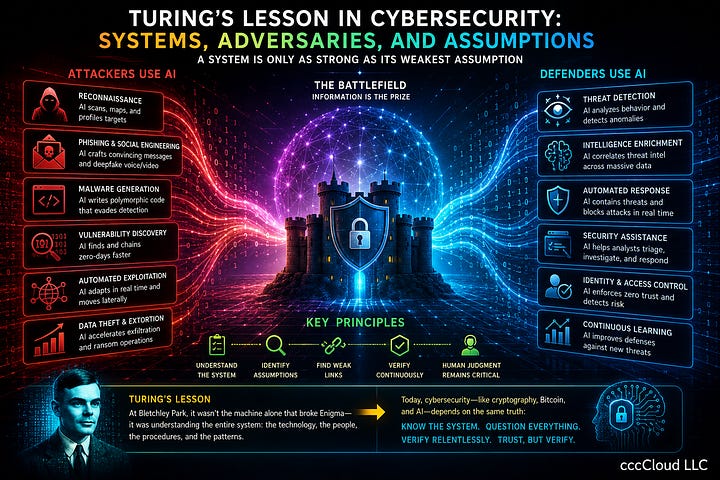
Today, cybersecurity must deal with AI on both sides.
Attackers will use AI to write better phishing emails, generate malware variants, automate reconnaissance, analyze leaked data, impersonate people, and accelerate social engineering.
Defenders will use AI to detect anomalies, summarize logs, classify incidents, write detection rules, assist reverse engineering, monitor network activity, and triage alerts.
This scenario becomes machine-assisted offense against machine-assisted defense.
That is not science fiction.
That is simply the next stage of the same pattern Turing saw in wartime cryptanalysis.
Information systems create power.
Adversaries attack that power.
Machines accelerate both sides.
The advantage goes to those who understand the system more deeply.
Turing and Bitcoin: Computation as Verification
Turing died long before Bitcoin existed.
But Bitcoin is impossible to understand without the computational world Turing helped define.
Bitcoin is not merely digital money.
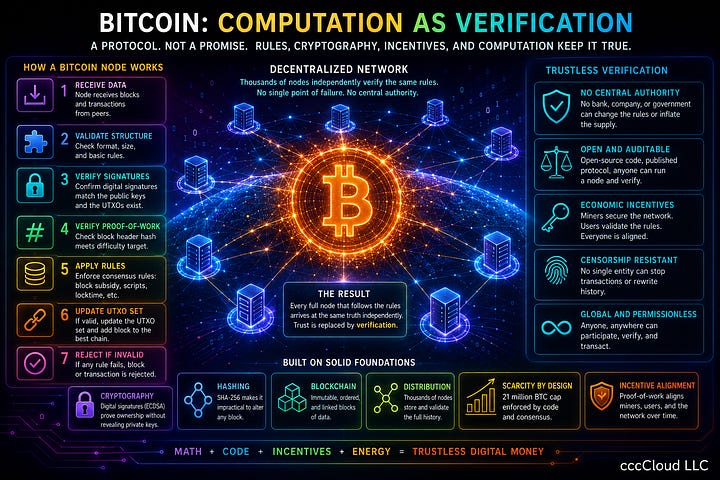
Bitcoin is a protocol-driven verification system.
Every full node receives blocks and transactions, applies rules, validates signatures, verifies proof-of-work, checks transaction structure, enforces monetary issuance, maintains the UTXO set, and rejects invalid data.
That is computation as sovereignty.
A Bitcoin node does not trust a bank.
It does not trust the government.
It does not trust a mining pool.
It does not trust a website.
It does not trust popular opinion.
It computes validity.
This is one of the purest expressions of the machine as an independent rule-enforcing system.
At the protocol level, Bitcoin depends on computation, cryptography, network consensus, economic incentives, open-source software, and local validation.
The old world asks an institution what is true.
Bitcoin asks the node.
The node computes.
That idea belongs deeply to the world Turing made possible.
A properly configured machine running known rules can independently evaluate claims about ownership, scarcity, and transaction validity.
The node does not believe.
The node verifies.
That distinction will matter even more in the AI age.
As synthetic content increases, as machine-generated claims multiply, as institutional trust continues to erode, verification will become one of the central virtues of the digital world.
Bitcoin teaches that lesson financially.
Turing teaches it computationally.
AI, Bitcoin, and the Coming Verification Crisis
Artificial intelligence will make content cheap.
Words will be cheap.
Images will be cheap.
Voice will be cheap.
Video will be cheap.
Documents will be cheap.
Fake authority will be cheap.
Synthetic confidence will be cheap.
Verification will become expensive.
That is the coming crisis.
In that world, the old internet habit of trusting what appears on a screen becomes dangerous. The future will require stronger verification tools: cryptographic signatures, provenance systems, audit trails, secure identity, reproducible builds, hardware-backed keys, source validation, proof systems, and serious human review.
This is where the worlds of Turing, cryptography, cybersecurity, Bitcoin, and AI converge.
Turing gave us the machine.
Cryptography gave us mathematical trust.
Bitcoin gave us decentralized monetary verification.
AI is giving us machine-generated abundance.
The next challenge is clear:
How does civilization preserve truth when machines can imitate almost anything?
That is not a small problem.
It is one of the central technical and cultural problems of the next decade.
The Limits of AI: Turing’s Warning Still Applies
Modern AI encourages overconfidence.
That is dangerous.
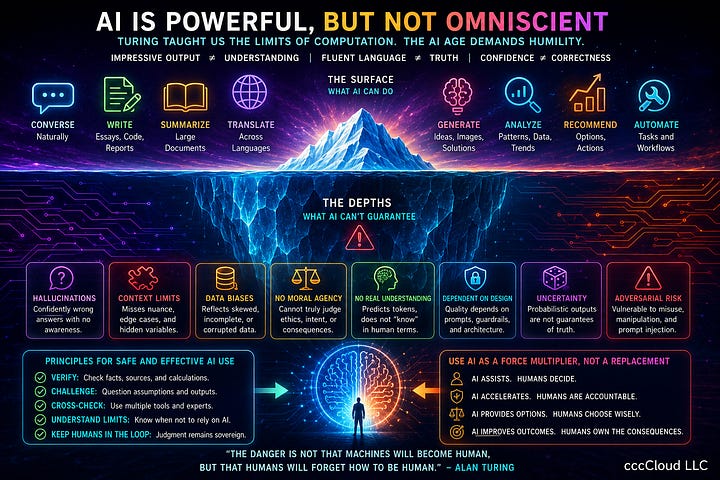
AI systems can be useful, powerful, and transformative, but they still have limitations.
They can hallucinate.
They can misunderstand context.
They can miss edge cases.
They can produce insecure code.
They can summarize without understanding legal consequences.
They can imitate moral judgment without possessing moral responsibility.
They can generate plausible analyses from incomplete data.
They can confuse correlation with causation.
They can present yesterday’s assumption as today’s fact.
They can produce outputs that are polished, persuasive, and wrong.
This should not surprise us.
Turing already taught us that computation has limits.
The machine can be powerful without being omniscient.
The machine can be useful without being wise.
The machine can imitate intelligence without becoming human.
The machine can pass certain behavioral tests and still fail outside its operating assumptions.
This is the proper view.
AI is not an oracle.
AI is not a priesthood.
AI is not a replacement for judgment.
AI is a force multiplier.
A serious user treats it as a disciplined technical instrument.
A careless user treats it as magic.
The difference will separate winners from victims.
Human Judgment Must Remain Sovereign
The most important word in the AI age may be judgment.
Machines can assist judgment.
Machines can accelerate research.
Machines can reveal patterns.
Machines can draft, summarize, classify, compare, generate, and recommend.
But machines do not carry human responsibility.
A machine does not go to court for poor legal advice.
A machine does not comfort a family after a medical failure.
A machine does not bear fiduciary duty after a financial error.
A machine does not hold moral accountability after a military mistake.
A machine does not understand the full human cost of a decision.
That burden remains with people.
This is not anti-AI.
It is pro-responsibility.
The best future is not one where man is replaced by machines.
The best future is man elevated by machine while still retaining moral agency, judgment, and accountability.
Turing asked whether machines could imitate thought.
He did not say mankind should surrender thought.
That distinction must remain clear.
Turing’s Tragedy and the Failure of His Own Civilization
No serious article about Alan Turing should ignore the tragedy of his life.
After helping Britain survive World War II, after helping build the foundations of modern computing, after serving his country at the highest intellectual level, Turing was prosecuted in 1952 under British laws criminalizing homosexual conduct.
He was punished by the state he helped defend.
That was a disgrace.
He died in 1954 at only 41 years old.
His life was cut short.
His work was not.
The British government later apologized. He was posthumously pardoned. His image now appears on the Bank of England £50 note. History eventually corrected the public honor.
But history did not give him back his years.
That fact should be stated plainly.
A civilization must be judged partly by how it treats its rarest minds.
Britain failed Alan Turing while he was alive.
The world has been trying to honor him ever since.
Why Turing Belongs in Every Serious Computer Science Education
A serious computer science education should not begin only with programming syntax.
Syntax changes.
Frameworks change.
Languages rise and fall.
Vendors come and go.
Tools become fashionable, then obsolete.
Foundations remain.
Students should understand Turing because Turing teaches the root questions:
What is computation?
What is an algorithm?
What is a machine?
What is a program?
What is memory?
What is symbolic representation?
What is decidability?
What can be automated?
What cannot be automated?
What does it mean for one machine to simulate another?
What does it mean for machine behavior to appear intelligent?
These questions matter more than any single programming language.
A person trained only on tools becomes obsolete when the tools change.
A person educated in foundations can survive every tool change.
That is why Turing still matters.
He is not merely history.
He is structured.
Turing’s Place in the Modern AI Revolution
The modern AI revolution has many fathers.
It includes mathematicians, computer scientists, neuroscientists, linguists, statisticians, engineers, chip designers, data center architects, open-source developers, and entrepreneurs.
But Turing stands near the beginning of the line because he framed the essential question before the tools existed.
He understood that machines would eventually force humanity to reconsider intelligence itself.
He did not have GPUs.
He did not have cloud computing.
He did not have transformer models.
He did not have the internet.
He did not have large-scale digital training data.
He did not have modern programming languages.
He did not have today’s memory, storage, or semiconductor density.
But he had the question.
And the question was enough to open the door.
Can machines think?
Today, the better question may be:
What happens when machines can imitate enough thinking to change the world?
That is where we are.
The Hard Historical Judgment
Alan Mathison Turing was one of the most important figures in the history of computing.
That is not an exaggeration.
It is the plain record.
He helped define computation through the Turing machine.
He described the universal machine, the conceptual ancestor of the general-purpose programmable computer.
He helped establish limits through undecidability and the halting problem.
He helped break Enigma and demonstrated the power of machine-assisted cryptanalysis.
He contributed to early stored-program computer design.
He framed artificial intelligence through the Turing Test.
His work touches every major layer of the modern digital world:
Computer science.
Cybersecurity.
Cryptography.
Artificial intelligence.
Software engineering.
Formal methods.
Protocol design.
Digital communications.
Bitcoin.
Machine intelligence.
Turing is not merely a historical figure.
He is an architectural figure.
The modern world was built partly on the ground he cleared.
Conclusion: Turing’s Question Is Now Our Reality
Alan Turing asked whether machines could think.
Today, machines write, speak, translate, code, summarize, classify, generate, recommend, imitate, and assist.
Whether that is truly “thinking” depends on how one defines the word.
But Turing’s deeper point was that machine behavior would eventually force the question.
He was right.
The AI age is not an escape from Turing.
It is the arrival of Turing’s problem on a global scale.
We now live with machines that manipulate language, simulate expertise, produce persuasive output, assist scientific work, write software, and enter human decision loops. That power will not go away. It will grow.
The correct response is not fear.
The correct response is disciplined understanding.
Understand the machine.
Understand the protocol.
Understand the assumptions.
Understand the limits.
Understand the verification layer.
Understand where human judgment must remain sovereign.
Turing gave us the conceptual foundation for computation.
He gave us the wartime example of machine-assisted intelligence.
He gave us the early framework for artificial intelligence.
He gave us the warning that machines have limits.
That is why Alan Mathison Turing remains one of the towering figures of computer history.
Not because he belongs to the past.
Because the future keeps proving him right.
You can sign up to receive emails each time I publish.
Here is the link to the original Bitcoin White Paper:
Dollar-Cost-Average Bitcoin: DCA-SWAN
Access to our high-net-worth Bitcoin investor technical services is available now: cccCloud
“This content is intended only for informational and educational purposes and should not be taken as financial, legal, medical, or investment advice. I am not a licensed financial advisor, securities analyst, attorney, physician, or medical professional. My background is as a protocol-level technical expert, systems analyst, security professional, and Bitcoin/blockchain researcher. Before making any major financial, legal, medical, or health-related decision, consult the appropriate qualified professional. While I make every reasonable effort to provide accurate information, I cannot guarantee completeness and future applicability. Verify independently and use sound judgment.”