
Alan Mathison Turing: The Man Who Defined the Machine Before the Machine Defined the World
Before AI, cloud computing, Bitcoin, and the modern software industry, Alan Turing defined what it means for a machine to compute—then helped prove that machine logic could change history.

Part 1 — Computation, Enigma, and the Birth of the Modern Computer Age
There are men who build machines.
There are men who improve machines.
And then there are rare men who define what a machine is before the world has enough machinery to understand the definition.
Alan Mathison Turing was one of those men.
Turing was not merely a British mathematician. He was not merely a wartime codebreaker. He was not merely one of the early voices in artificial intelligence. Those descriptions are all true, but they are too small.
Turing belongs in the small group of people who changed the root structure of the modern world.
He did not simply contribute to computer science.
He helped create the intellectual frame inside which computer science became possible.
Before silicon chips, before operating systems, before compilers, before databases, before Unix, before Bitcoin, before cloud computing, before artificial intelligence became a commercial and civilizational force, Turing asked a more basic question:
What does it mean for a machine to compute?
That question is still alive.
Every CPU instruction cycle, every compiler pass, every cryptographic hash, every Bitcoin node validation rule, every artificial intelligence inference engine, every operating system scheduler, every distributed protocol, every secure communications channel, and every modern software system lives under the shadow of that question.
Turing did not merely look at machinery.
He looked through the machinery.
He saw the logic underneath.
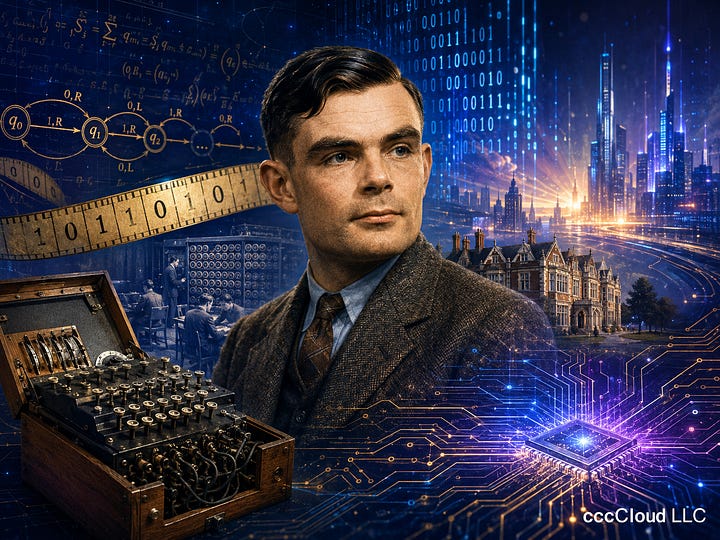
The 1936 Paper: Where Modern Computing Begins
In 1936, Alan Turing published one of the most important papers in the history of mathematics and computer science:
“On Computable Numbers, with an Application to the Entscheidungsproblem.”
The title sounds like something locked away inside academic history.
It is not.
That paper is one of the cornerstones of the digital age.
Turing was addressing a deep mathematical problem connected to logic, proof, and decidability. But in doing so, he created something far larger than the immediate mathematical question. He gave the world a formal model of computation.
That model became known as the Turing machine.
The Turing machine is not a computer in the modern physical sense. It is not a rack of vacuum tubes. It is not a processor. It is not memory chips. It is not a keyboard, display, disk, network card, or GPU.
It is an abstract machine.
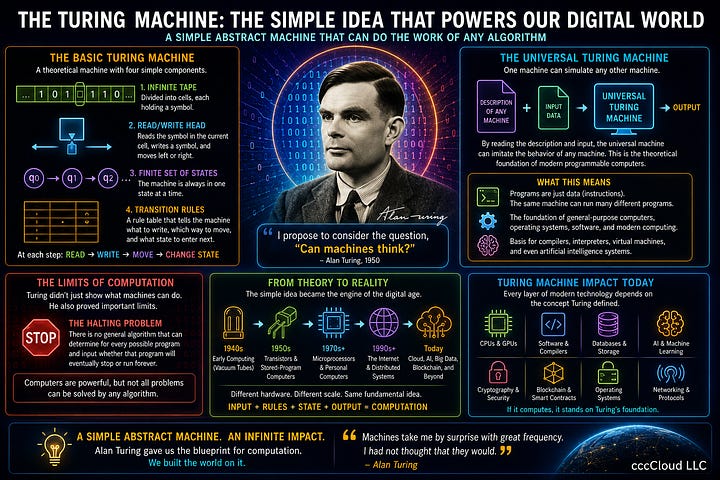
At its simplest, it contains a tape divided into cells, a read/write head that can inspect one cell at a time, a finite set of internal states, and a rule table that tells the machine what to do next.
At each step, the machine reads a symbol, writes a symbol, moves left or right, changes state, and continues.
That sounds almost primitive.
But primitive things often carry the deepest power.
Turing showed that this simple abstract machine could describe the essence of algorithmic computation. A computation is a process of symbolic transformation performed step by step according to rules.
That is the foundation.
The modern machine is faster, denser, electronic, parallel, networked, and layered through mountains of abstraction. But at the protocol level, the essential nature remains the same.
Read state.
Apply the rule.
Write the result.
Move forward.
That is computation.
Turing stripped the machine down to its bones.
The Universal Turing Machine: The Seed of General-Purpose Computing
The most important leap was not merely the Turing machine.
It was the universal Turing machine.
A normal Turing machine can be constructed to perform a specific computation. But Turing described a universal machine that could simulate any other Turing machine, provided it was given the correct description and input.
That sounds abstract.
It is not abstract anymore.
It is the conceptual ancestor of the modern programmable computer.
A general-purpose computer is not rebuilt every time it performs a new function. The same physical machine can become a word processor, a compiler, a video editor, a Bitcoin node, a database server, a simulation engine, an AI inference server, or a secure signing device depending on the instructions it is given.
That is the central magic of modern computing:
The machine does not have to change.
The program changes.
This is one of the great intellectual transitions in human history.
Before general-purpose computing, many machines were dedicated to particular tasks. A machine was often defined by its mechanical construction. It did one thing because its physical structure forced it to do that thing.
Turing separated the idea of the machine from the idea of the task.
That separation created the modern software world.
Hardware became the substrate.
Software became the behavior.
The program plus the machine became the system.
This is why Turing’s work sits underneath the entire computer industry. The universal machine is the ghost inside every modern computer architecture.
The Machine Became a Symbol Engine
Turing’s brilliance was not only mathematical.
It was architectural.
He understood that computation was not merely arithmetic. It was not just numerical calculation. It was symbolic manipulation.
That insight is enormous.
A machine can process numbers.
But a machine can also process symbols.
Letters.
Instructions.
Logical states.
Keys.
Addresses.
Tokens.
Memory locations.
Programs.
Encrypted messages.
Rules.
This is the bridge from calculation to computation.
It is also the bridge from computation to artificial intelligence.
Once a machine can manipulate symbols according to rules, it can be used to represent far more than just numbers. It can represent language, logic, proofs, games, protocols, transactions, contracts, identities, images, sounds, and eventually patterns extracted from enormous datasets.
The machine becomes a general symbolic engine.
That is where Turing’s work becomes so relevant to the modern age.
Large language models seem new because their scale is unprecedented.
The training data is new.
The GPU infrastructure is new.
The transformer architecture is new.
The commercial impact is new.
But the deeper idea that a machine can operate on symbolic representations and produce meaningful behavior is not new.
Turing saw that door opening in the first half of the twentieth century.
We are now walking through it at an industrial scale.
The Halting Problem: Turing Also Defined the Limits
A lesser thinker might have stopped at what machines can do.
Turing also showed what machines cannot do.
This is just as important.
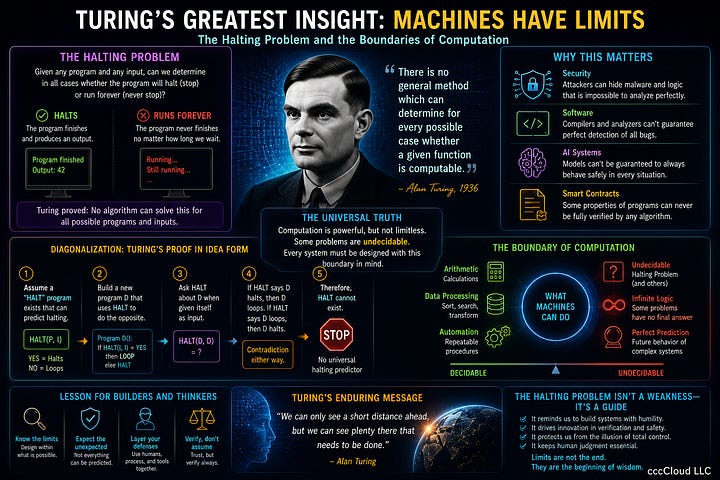
Turing’s work led directly to one of the great results in computer science: the halting problem.
The problem asks whether there can be a general algorithm that determines, for every possible program and input, whether that program will eventually stop or continue forever.
Turing showed that no such universal method exists.
That result is not a technical footnote.
It is a warning carved into the foundation of computing.
There are limits to what can be mechanically decided.
There are boundaries to algorithmic certainty.
There are truths about programs that cannot be fully determined by another general-purpose program in all cases.
This matters profoundly today.
We live in a time when people are tempted to believe that enough compute, enough data, enough AI, and enough money can solve every problem.
That is false.
Turing showed that computation is powerful, but it is not omnipotent.
The machine is a miracle.
But it is not magic.
This matters in software verification. It matters in cybersecurity. It matters in compiler design. It matters in artificial intelligence. It matters in autonomous systems. It matters in smart contracts. It matters in distributed consensus. In any system, it matters when people begin to believe that automation can fully tame complexity.
A serious technologist never forgets this:
Computers expand human power.
They do not abolish logical limits.
Turing gave us that lesson early.
Bletchley Park: When Computation Went to War
Turing’s theoretical work alone would have made him historically important.
But then came World War II.
At Bletchley Park, Britain’s codebreaking center, Turing became one of the central figures in the Allied attack against German encrypted communications, especially the Enigma system.
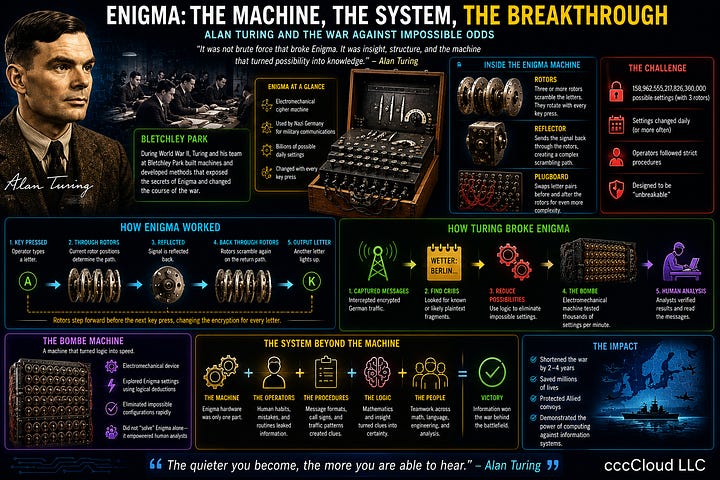
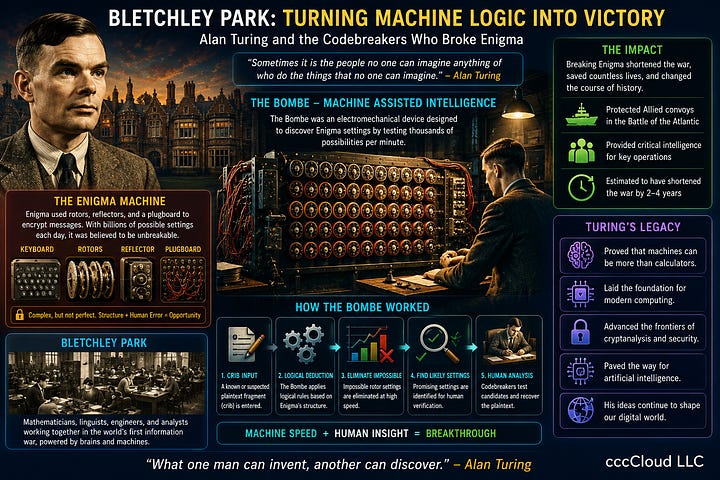
The Enigma machine was an electromechanical cipher device used by Nazi Germany. It used rotors, a reflector, plugboard connections, changing settings, and daily keys to produce encrypted messages. Its purpose was to protect military communication across land, sea, and air.
The German belief was simple:
The number of possible settings was so large that the cipher was practically unbreakable.
That belief was wrong.
But it was not wrong because Enigma was easy.
It was wrong because the system had an exploitable structure, operational weaknesses, and human patterns. Turing understood that cryptanalysis was not merely about brute force. It was about reducing uncertainty.
At a protocol level, Enigma can be understood as a stateful substitution system. Its rotor positions changed with each character. That meant the same plaintext letter would not encrypt the same way every time. The machine created a moving substitution cipher with a huge configuration space.
But the system had properties that could be attacked.
One famous property was that Enigma would not encrypt a letter as itself. That structural rule created logical openings. Operators also made mistakes. Repeated phrases, predictable message formats, weather reports, military routines, and known plaintext fragments created possible entry points.
These fragments were called cribs.
A crib is a suspected piece of plaintext that may correspond to part of an encrypted message.
From a systems point of view, a crib reduces the search space. It gives the analyst a foothold.
Turing’s work helped turn this into a disciplined machine-assisted process.
The Bombe: Logic, Search, and Machine-Assisted Cryptanalysis
Turing helped develop the British Bombe, building on earlier Polish cryptanalytic work.
The Bombe was not a modern digital computer. It was an electromechanical cryptanalytic machine designed for a specific purpose: to help discover Enigma settings.
Its job was not to “read German” in the human sense.
Its job was to eliminate impossible settings at machine speed.
That distinction matters.
The Bombe was a search-reduction machine.
It used logical implications derived from cribs and the Enigma structure to test possible rotor settings. Instead of trying everything blindly by hand, it used electromechanical logic to reject large numbers of impossible configurations.
This is one of the deep patterns in modern computer science:
Reduce the search space.
Exploit structure.
Automate the repetitive logic.
Leave final interpretation to trained analysts.
That pattern is still with us.
It appears in cryptanalysis.
It appears in SAT solvers.
It appears in symbolic execution.
It appears in intrusion detection.
It appears in password cracking.
It appears in machine learning search spaces.
It appears in artificial intelligence model optimization.
It appears anywhere a vast problem becomes manageable only after structure is discovered and exploited.
Turing was operating in that world before most people understood that world existed.
Naval Enigma and the Harder Problem
The German Navy’s Enigma traffic was especially difficult and especially important.
The Battle of the Atlantic was a supply-line war. Britain depended on shipping. German U-boats hunted convoys. If Allied codebreakers could read naval traffic, they could help reroute convoys and reduce losses.
Naval Enigma was harder than other Enigma systems because of tighter procedures, additional complexity, and better operational discipline.
Turing worked heavily on naval Enigma.
This is where his contribution moves beyond the simple public legend.
Popular history often compresses codebreaking into one heroic moment: a genius man breaks a machine, and the war is saved.
The real story is more technical and more impressive.
Breaking Enigma was a continuous industrial process involving mathematics, captured materials, traffic analysis, operator mistakes, machine engineering, operational security, disciplined secrecy, and relentless daily work.
Turing’s mind was central because he understood the problem as a complete system.
The cipher machine mattered.
The operators mattered.
The message formats mattered.
The military routines mattered.
The machine assistance mattered.
The probability mattered.
The workflow mattered.
The secrecy mattered.
That is protocol-level thinking.
The system is never just the device.
The system is the device plus the users plus the procedures plus the assumptions plus the adversary.
That lesson applies today to every cryptographic and security system.
A modern hardware wallet can use strong cryptography and still fail through bad seed handling.
A messaging system can use strong encryption and still fail through metadata leakage.
Even with strong consensus rules, a blockchain can still be affected by poor custody practices.
An AI system can use advanced model architecture and still fail through bad data, bad alignment, or bad deployment controls.
Turing’s world teaches us that the whole system matters.
Colossus, Flowers, and Giving Credit Properly
Any serious discussion of wartime computing should also be careful with credit.
Turing was central to Enigma work, but he was not the only major figure at Bletchley Park.
The Colossus machines, associated especially with Tommy Flowers, were built to attack German Lorenz cipher traffic. Colossus was not the same thing as the Bombe, and Lorenz was not Enigma.
This distinction matters.
The Bombe was primarily associated with Enigma cryptanalysis.
Colossus was an electronic machine used against Lorenz-encrypted high-level German communications.
Colossus deserves recognition as one of the great wartime computing achievements. Tommy Flowers deserves enormous credit as an engineer who pushed electronic computation forward under extreme pressure.
Turing’s greatness does not require taking credit away from others.
The truthful version is stronger.
Bletchley Park was one of the earliest examples of large-scale interdisciplinary technical warfare: mathematicians, linguists, engineers, operators, clerks, intelligence analysts, and machine designers working together against information systems.
That was the future arriving early.
Modern computing was not born in one clean place.
It emerged from mathematics, wartime necessity, electrical engineering, cryptography, communications, and bureaucracy.
Turing stands at the center of that story because his work connected the theory of computation with the practical attack on encrypted information.
ACE: Turing the Computer Designer
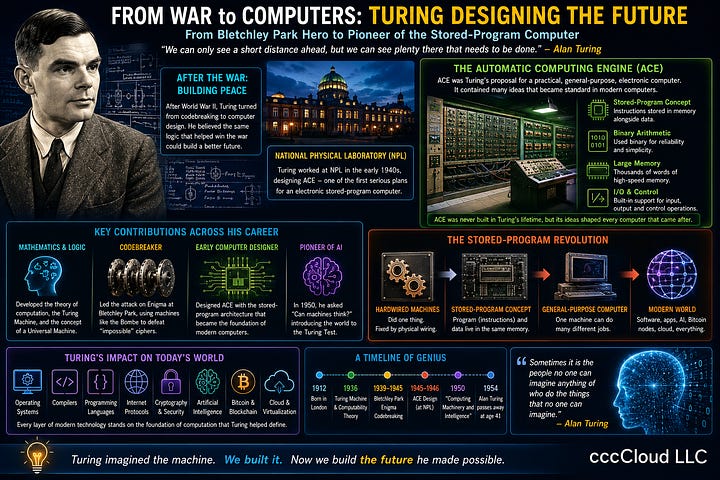
After the war, Turing worked at Britain’s National Physical Laboratory on the Automatic Computing Engine, or ACE.
This part of his life is often underappreciated.
Turing was not only a theoretical pioneer and codebreaker. He also worked on actual computer design.
The ACE design was one of the early serious designs for a stored-program electronic computer. A stored-program machine holds instructions in memory along with data. That idea became central to modern computing.
At the system level, this is the point where the computer becomes truly flexible.
Instructions are not fixed only by wiring.
Instructions can be stored, loaded, modified, and executed.
That is the modern world.
A stored-program computer treats programs as data that can be placed in memory. This allows a machine to be reconfigured by loading new instructions rather than rebuilding physical circuitry.
That concept now feels ordinary.
But ordinary things are often the result of revolutionary ideas becoming successful.
Modern operating systems depend on this.
Compilers depend on this.
Application software depends on this.
Virtual machines depend on this.
Containers depend on this.
Cloud infrastructure depends on this.
AI runtimes depend on this.
Bitcoin node software depends on this.
The stored-program idea is one of the reasons computing became civilization-scale infrastructure rather than merely specialized machinery.
Turing helped push that world forward.
Turing Before the Modern Stack
It is useful to look at Turing from the viewpoint of the modern computing stack.
Today we think in layers.
Hardware.
Firmware.
Operating systems.
Compilers.
Runtime environments.
Applications.
Networks.
Cryptographic protocols.
Distributed systems.
Artificial intelligence models.
User interfaces.
Governance and security policy.
Turing worked before most of these layers existed in their modern form.
But he helped define the layer below them all.
The computational layer.
That is why his work survives every generation of technology.
Vacuum tubes gave way to transistors.
Transistors gave way to integrated circuits.
Integrated circuits gave way to microprocessors.
Mainframes gave way to minicomputers.
Minicomputers gave way to personal computers.
Personal computers connected through networks.
Networks became the internet.
The internet became cloud infrastructure.
Cloud infrastructure became the foundation of AI.
Yet the underlying truth remains:
A machine receives input, transforms state according to rules, and produces output.
That is the enduring line from Turing to today.
The machinery changes.
The principle remains.
Turing and the Discipline of Systems Thinking
One of Turing’s greatest qualities was that he did not think like a narrow specialist.
He moved across boundaries.
Mathematics.
Logic.
Cryptanalysis.
Machine design.
Probability.
Language.
Intelligence.
Systems.
That is why his work still speaks to serious technologists.
Modern technology fails when people think only in silos.
The hardware person sees hardware.
The software person sees software.
The security person sees controls.
The business person sees the product.
The user sees convenience.
The adversary sees the gap between all of them.
Turing’s world teaches the opposite lesson.
The whole system matters.
The assumptions matter.
The human operator matters.
The protocol matters.
The machine matters.
The adversary matters.
The edge case matters.
The workflow matters.
The failure mode matters.
That is what made Turing so effective at Bletchley Park. He understood that Enigma was not just a machine. It was a living operational system used by human beings under wartime conditions.
The same thinking applies today.
A secure system is not secure because the brochure says it is secure.
A Bitcoin wallet is not secure because the cryptography is strong.
An AI system is not trustworthy because the output is polished.
A cloud platform is not resilient because the architecture diagram looks clean.
A protocol is not sound because the whitepaper is impressive.
The serious question is always the following:
Where are the assumptions?
Where are the weak links?
Where does the machine meet the human?
Where does theory meet operation?
Turing lived with that question.
So should we.
Turing’s Place Among the Greats
Computer history is not a one-man story.
It never was.
Charles Babbage imagined programmable mechanical calculation.
Ada Lovelace saw that machines might manipulate symbols beyond arithmetic.
George Boole gave logic an algebra.
Claude Shannon connected Boolean logic to switching circuits and created information theory.
John von Neumann helped define the stored-program architecture that shaped the computer age.
Tommy Flowers helped bring large-scale electronic wartime computing into reality.
Grace Hopper helped advance programming languages and compilers.
Many others built the machines, languages, operating systems, networks, and protocols that carried computing forward.
But Turing occupies a special place.
He gave computation its formal skeleton.
He helped show the limits of computation.
He helped apply machine logic to wartime cryptanalysis.
He helped design early stored-program computers.
He later asked whether machines could display intelligence.
That span is astonishing.
Turing sits at the crossing of logic, machinery, cryptography, and intelligence.
That crossing is where the modern world lives.
Why Part 1 Matters Before Part 2
It is tempting to begin Turing’s story with artificial intelligence because AI is the great question of our time.
But that would be backwards.
Turing’s AI work matters because his computation work came first.
Before a machine can imitate thought, the machine must compute.
Before a model can generate language, the system must represent symbols.
Before AI can answer a question, hardware and software must transform input into output.
Before machine intelligence can become a social force, computation must exist as a disciplined technical reality.
That is why Part 1 matters.
Turing’s early work gave the machine its formal body.
His wartime work gave machine-assisted logic historical force.
His ACE work moved him toward real electronic computer design.
Only then does the later AI question fully make sense.
The road to artificial intelligence runs through computation.
And the road through computation runs straight through Alan Mathison Turing.
Conclusion: The Man Who Gave the Machine Its Foundation
Alan Mathison Turing did not merely predict the computer age.
He helped make it intellectually possible.
He defined computation in formal terms.
He described the universal machine.
He showed that computation has limits.
He helped turn wartime cryptanalysis into machine-assisted logic.
He contributed to early stored-program computer design.
He demonstrated, by his work and by his method, that machines were not merely tools for arithmetic. They could become symbolic engines, rule-following systems, cryptographic attackers, verification devices, and eventually participants in the greatest question of the modern age:
Can machines imitate thought?
That question belongs to Part 2.
But Part 2 only has weight because Part 1 exists.
Turing’s first great achievement was not asking whether machines could think.
His first great achievement was showing what it means for a machine to compute.
That is why his place in computer history is not decorative.
It is structural.
The modern world runs on computation.
Alan Turing helped define computation before the modern world knew how badly it would need it.
Part 2 of 2 of this series will be posted later this month.
You can sign up to receive emails each time I publish.
Here is the link to the original Bitcoin White Paper:
Dollar-Cost-Average Bitcoin: DCA-SWAN
Access to our high-net-worth Bitcoin investor technical services is available now: cccCloud
This content is intended only for informational and educational purposes and should not be taken as financial, legal, medical, or investment advice. I am not a licensed financial advisor, securities analyst, attorney, physician, or medical professional. My background is as a protocol-level technical expert, systems analyst, security professional, and Bitcoin/blockchain researcher. Before making any major financial, legal, medical, or health-related decision, consult the appropriate qualified professional. While I make every reasonable effort to provide accurate information, I cannot guarantee completeness and future applicability. Verify independently and use sound judgment.